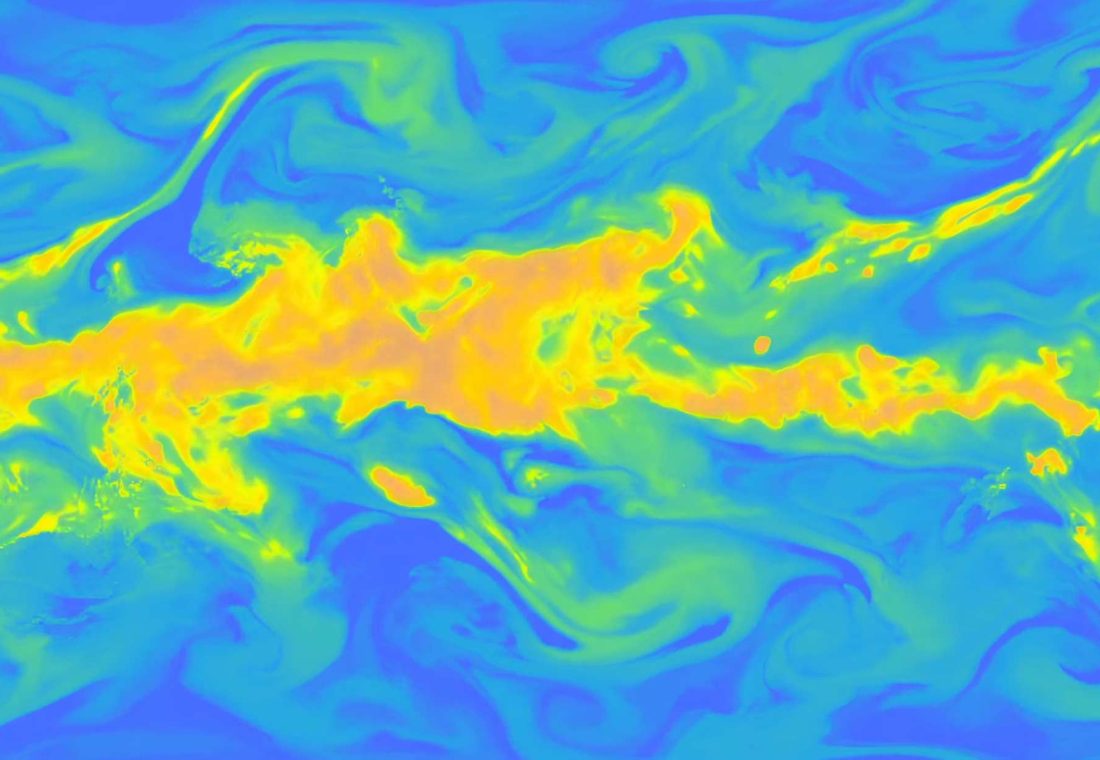

Tropical cyclones kill. According to the World Meteorological Organization, these storms have claimed more than 779,000 lives and caused $1.4 trillion in economic damage over the past 50 years. The math works out to 43 deaths and $78 million in losses every single day. Forecasting accuracy has improved incrementally over decades, but the physics-based models that dominate operational meteorology still require massive supercomputing resources and hours of runtime. Every extra hour of warning matters. But until now, gains have come slow.
Google DeepMind wants to change the timeline.

An Extra Day of Warning
On August 6, the company published research in Nature demonstrating that its WeatherNext AI model achieved state-of-the-art accuracy in predicting cyclone track, intensity, and wind structure. The headline finding: three-day forecasts from WeatherNext now match the accuracy that previous models could only deliver at two days. That translates to roughly 24 extra hours of reliable warning before a storm makes landfall.
The model runs a 15-day, 1,000-member ensemble forecast in under a minute on a single Tensor Processing Unit. Traditional physics-based systems doing comparable work would take hours on a supercomputer. WeatherNext generates not a single deterministic prediction but a probability distribution across 1,000 possible scenarios, helping forecasters identify rare but catastrophic tail-risk events like rapid intensification.
Advertisement
Speed alone isn’t the breakthrough. The more striking result is how little resolution the system requires. WeatherNext Cyclones operates on 28-kilometer input data. A smaller variant runs on 111-kilometer inputs. Physics-based regional models typically demand resolution orders of magnitude finer. Why accuracy survives this coarsening, DeepMind acknowledges, remains an open research question.
Tested in the Field
WeatherNext already has a proof point. During the 2025 Atlantic hurricane season, the National Hurricane Center ran the model alongside operational guidance and used it to forecast Hurricane Melissa’s rapid intensification and catastrophic landfall in Jamaica. The advance warning gave communities critical time to prepare.
Melissa was no ordinary storm. The Category 5 hurricane struck southwestern Jamaica on October 28, 2025, with sustained winds of 185 miles per hour. World Bank and Inter-American Development Bank assessments put physical damage at $8.8 billion, equivalent to 41 percent of Jamaica’s 2024 GDP. The storm killed at least 45 people and displaced tens of thousands. Without the earlier warning enabled by AI forecasting, casualty figures could have been worse.
Architecture Under the Hood
WeatherNext builds on DeepMind’s earlier work with GraphCast, a graph neural network model published in Science in 2023 that outperformed the European Centre for Medium-Range Weather Forecasts’ operational system on 90 percent of tested variables. But GraphCast produced single deterministic forecasts. WeatherNext uses Functional Generative Networks, a diffusion-based approach that samples from the joint distribution over 15-day global weather trajectories. Each ensemble member is a dynamically coherent alternative future, not point-wise noise.
The system was co-trained on approximately 20 terabytes of global atmospheric data alongside the IBTrACS historical database of nearly 5,000 tropical cyclones. Historically, forecasting agencies maintained two separate model pipelines: coarser global models for tracking a storm’s path, and specialized high-resolution local models for predicting intensity. WeatherNext collapses that architecture into a single unified model that learns both simultaneously.
Advertisement
Open Source, Commercial License
DeepMind released the code and model weights on GitHub under the Apache 2.0 license, with accompanying materials under Creative Commons Attribution 4.0. Both permit commercial use with attribution. This marks a shift from DeepMind’s earlier weather releases, which carried non-commercial restrictions. For forecasting vendors, energy traders, and insurers, the distinction matters. The technology is now usable in commercial products, not just academic research.
Three variants are available: WeatherNext Cyclones, WeatherNext 2, and a compact WeatherNext 2-mini capable of running in a free Google Colab notebook. Live outputs are accessible through Weather Lab, DeepMind’s interactive platform within the Google Earth AI umbrella.
On the Horizon
The model family is already being integrated into Google’s consumer-facing weather products: Search, Gemini, Pixel Weather, and the Maps Platform Weather API. DeepMind says future development may extend the approach to other extreme weather events beyond tropical cyclones.
If early warning systems have driven the threefold reduction in cyclone deaths over the past five decades despite rising economic losses, then AI-accelerated forecasting represents the next multiplier. The gains will not be evenly distributed. Poorer nations with less infrastructure still bear the brunt of storm impacts. But open-sourcing the model weights removes one barrier; the challenge now is only in the deployment.