

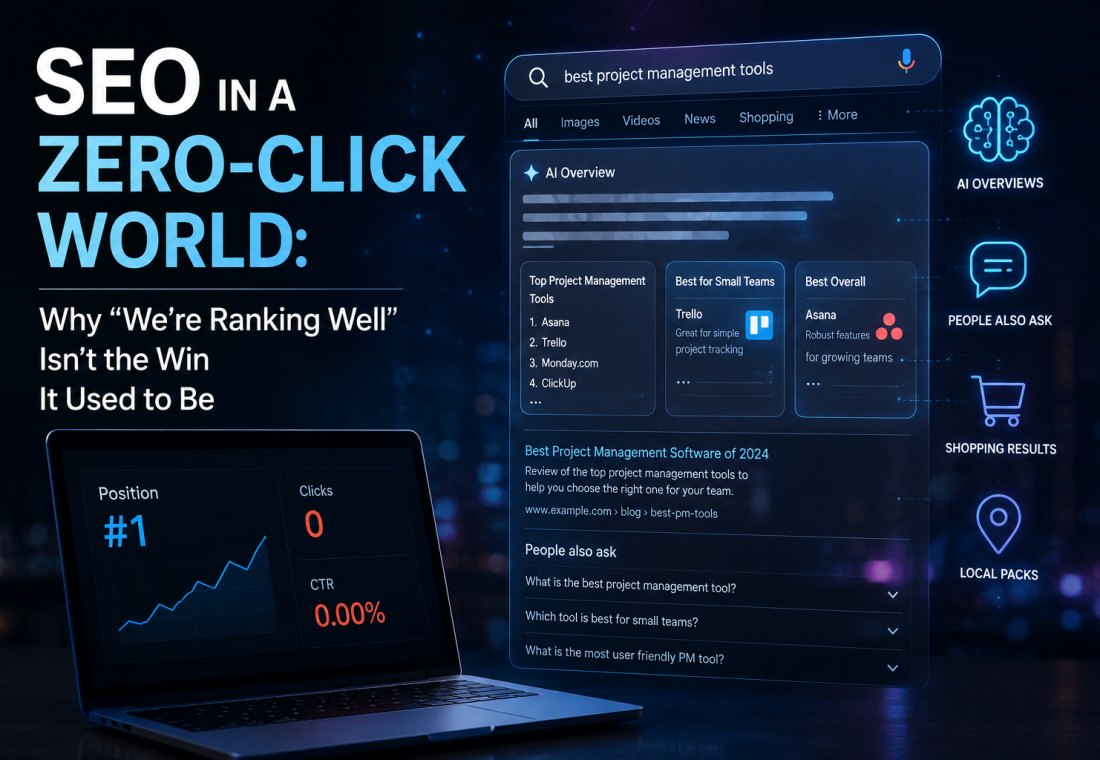
A few months back I had a call with a client who pulled up their rank tracker mid-conversation, visibly relieved, and said “see, we’re still #2.” I had to be the one to point out that #2 on that keyword now sits below an AI Overview, a shopping carousel, and two People Also Ask boxes. Being #2 on a page like that isn’t the same job it was two years ago. This is the conversation more and more SEO teams are having, and it’s worth actually unpacking instead of just accepting the traffic drop as a mystery.
What “Zero-Click” Actually Means Right Now
Quick Answer: A zero-click search is any search where the user gets their answer without clicking through to any website. In 2026, this now describes a majority of all Google searches, not a fringe minority.
The numbers here vary depending on which research firm you look at, but they all point the same direction. 68.01% of U.S. Google searches ended without a single click during the first four months of 2026, up from 60.45% in 2024, a 7.56-point jump in two years. Other measurement methodologies land in a similar range: between 58.5% and 68% of Google searches now end without a click to any website.
The click decline isn’t evenly distributed. It concentrates hardest exactly where AI Overviews concentrate. Position 1 in Google has a CTR of 31.7% without any SERP features present, but only 19.4% when all possible SERP features are present nearly cut in half just by the crowding above it.
Why This Isn’t the Same as “SEO Stopped Working”
Quick Answer: Total organic traffic worldwide has still grown even as the click-through rate per search has fallen, because search volume itself keeps growing faster than the CTR decline. The problem isn’t that search stopped sending traffic, it’s that the traffic per ranking has changed, and averages hide who’s actually losing.
This distinction matters for how you talk to clients or leadership about this. Despite the CTR decline, total organic search traffic worldwide has increased by 8% since 2020, thanks to growing search volume. But that aggregate number can mask real damage at the individual keyword or content-type level.
The damage is concentrated, not universal. Organic session volumes have dropped 15–40% for informational content categories since AI Overviews expanded, with publishers in education, health, finance, and how-to niches reporting the steepest declines. If your content mix skews heavily informational, the aggregate “SEO is fine” story can hide a real, category-specific problem.
There’s also a quality-over-quantity silver lining worth taking seriously. Brands cited in AI Overviews earn roughly 35% more organic clicks and convert visitors at 4–9x higher rates than uncited pages, the users who do click after seeing an AI summary have already been pre-qualified by it, arriving with clearer intent than a cold click ever had.
How to Actually Measure What’s Happening to Your Traffic
Quick Answer: Stop measuring SEO success by traffic volume alone and start layering in SERP feature presence, click-through rate by keyword, and citation visibility, three metrics that together explain why traffic moved, not just that it did.
The measurement gap most reports have
Traditional measurement frameworks only capture the fraction of search value that converts to a click, ignoring the growing share of value delivered through AI citation impressions, brand awareness, and downstream direct traffic effects. If your reporting only shows sessions and conversions, you’re missing the part of the funnel that’s increasingly where the real activity is happening.
A practical measurement stack
- Rankings– still the foundation. Most AI citations pull from already-ranking content, so position hasn’t stopped mattering.
- Click-through rate per keyword, tracked over time– a flattening or falling CTR on a stable ranking is the clearest signal that something changed above it in the SERP, not in your content.
- SERP feature presence– whether AI Overviews, shopping modules, or expanded PAA boxes now occupy space that used to be organic real estate.
- Citation visibility– whether your content is actually quoted or summarized when an AI Overview appears, versus simply ranking below it unseen.
This is where combining a rank tracker with real SERP visibility earns its keep. FreeSERP‘s Rank Tracking and SERP Checker together show both halves of this at once, the position, and what the SERP actually looks like around it, instead of forcing you to manually screenshot search results every time a client asks why traffic dropped despite “good rankings.” Layering in Google Search Console Integration adds the click-through-rate side of the picture, so you’re comparing position against actual click behavior on the same keyword, over the same time window, instead of eyeballing two separate reports and guessing at the connection.
What to Prioritize Now vs. Two Years Ago
Quick Answer: Shift weight toward transactional and highly specific long-tail keywords where zero-click behavior is less dominant, while still investing in informational content aimed at earning AI citations rather than raw clicks.
| Priority | Two Years Ago | Now |
| Primary success metric | Sessions and clicks | Sessions, CTR trend, and citation visibility together |
| Informational content goal | Drive traffic directly | Earn citation + support branded search lift |
| Keyword selection | Volume-first | Volume balanced against zero-click risk for that query type |
| Reporting to clients/leadership | Ranking + traffic charts | Ranking + SERP feature context + CTR trend |
| Content freshness | Nice to have | Directly tied to AI citation likelihood |
Common Mistakes in a Zero-Click Environment
- Reporting only session totals without noting SERP feature changes that explain the trend
- Chasing high-volume informational keywords that are now dominated by AI Overviews, when a more specific long-tail variant would convert better with less zero-click risk
- Treating every traffic dip as a content quality problem when it’s often a SERP composition problem instead
- Ignoring branded search as a metric, it tends to rise when citation visibility rises, even without a corresponding click
- Failing to segment content by type before drawing conclusions, informational and transactional pages are being affected very differently
Zero-Click Adaptation Checklist
- Segmented traffic reporting by content type (informational vs. transactional)
- Reviewed CTR trend per keyword, not just aggregate site traffic
- Checked SERP feature presence on top declining keywords
- Confirmed whether declining-traffic pages are still cited inside AI Overviews
- Adjusted keyword targeting weight toward lower zero-click-risk queries where appropriate
- Updated reporting templates to include SERP context alongside rankings
- Set a recurring cadence (not a one-time check) for monitoring CTR and SERP feature shifts
FAQ
What does zero-click search mean? A search where the user finds their answer directly on the results page and doesn’t click through to any website.
How common are zero-click searches now? Estimates for 2026 generally range from roughly 58% to 68% of Google searches, depending on the study and region.
Does a zero-click search mean my SEO failed? No, it reflects a structural change in the SERP, not necessarily a drop in content quality or ranking effectiveness.
Has total organic search traffic actually declined industry-wide? Not in aggregate, total traffic has grown due to rising search volume, even though the click-through rate per search has fallen.
Which content types are most affected by zero-click search? Informational and “how to” content is affected the most; transactional and product pages see a much smaller decline.
Should I stop targeting high-volume informational keywords? Not entirely, they still drive citations and brand visibility, but it’s worth balancing them against more specific long-tail queries less affected by zero-click behavior.
How do I measure success if fewer searches lead to clicks? Track CTR trends, SERP feature presence, and citation visibility alongside traditional traffic and conversion metrics.
Do zero-click searches still provide any business value? Yes, particularly through brand visibility, branded search lift, and higher-intent visitors among the clicks that do occur.
Is it true that clicks that do happen convert better now? Yes, several studies show meaningfully higher conversion rates among visitors who click through after seeing an AI-generated summary first.
How do I explain a traffic drop to a client if rankings haven’t changed? Show the SERP composition change (like a new AI Overview) alongside the ranking and CTR data, it reframes the conversation accurately.
What’s the best way to track CTR changes per keyword? Combining rank tracking data with Search Console click data for the same keyword and time period gives the clearest picture.
Do all industries see the same zero-click impact? No, education, health, finance, and how-to niches report some of the steepest declines, while more transactional categories are less affected.
Is position 1 still valuable if there’s an AI Overview above it? Yes, largely because AI Overviews frequently cite content that’s already ranking well, the ranking remains the foundation for citation, even if direct clicks fall.
Should keyword research change because of zero-click trends? It’s worth factoring zero-click risk into keyword prioritization alongside traditional volume and difficulty metrics.
How do I know if a specific keyword has become zero-click dominant? Check the live SERP for that keyword and compare current CTR against historical CTR for the same ranking position.
Does content freshness affect zero-click outcomes? Yes, more recently updated content tends to perform better both in ranking and in earning citations within AI-generated summaries.
Are branded searches a good metric to track alongside traffic? Yes, rising branded search volume often correlates with growing visibility in AI-generated answers, even without direct clicks.
Can smaller sites still compete in a zero-click environment? Yes, citation and visibility appear to reward content clarity and freshness rather than site size alone.
Is it worth restructuring existing content to be more “quotable” for AI summaries? Often yes, especially for high-traffic informational content that’s seeing declining CTR despite stable rankings.
How often should SERP feature presence be checked for tracked keywords? Regularly and ongoing, SERP composition shifts over time, so a one-time audit quickly goes stale.
Do zero-click trends affect local search the same way? Local search has its own dynamics (map packs, local packs) that behave somewhat differently, though local queries aren’t immune to zero-click behavior either.
What’s the risk of ignoring zero-click trends in SEO reporting? Reports built on click and traffic totals alone can misrepresent whether SEO efforts are actually working, especially for informational-heavy content strategies.
Should paid search budget shift because of organic zero-click trends? Some brands are reallocating budget toward ensuring visibility in AI-cited results, though this depends heavily on category and competitive dynamics.