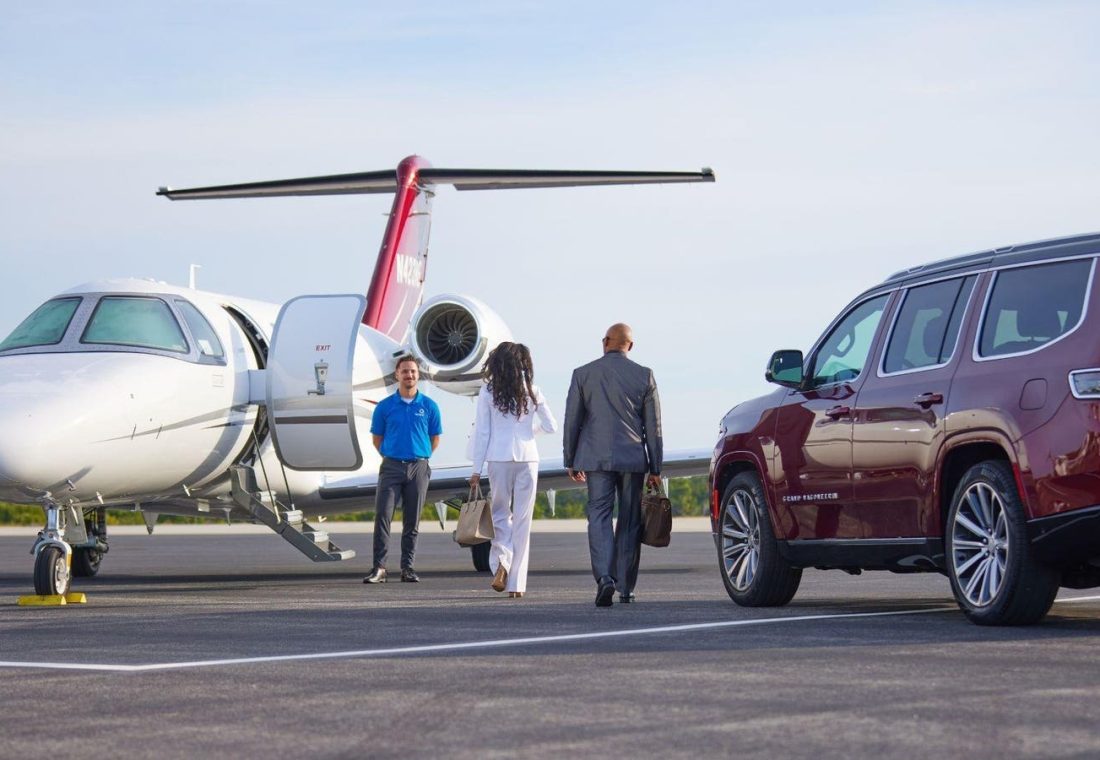

Today, more business leaders are evaluating travel through the lens of productivity, opportunity cost, and operational efficiency.
Jet OUT
For decades, private aviation has largely been viewed as a luxury: a way to skip security lines, avoid crowded terminals, and fly on your own schedule. But according to executives and industry leaders, that’s no longer the only—or even the primary—conversation.
“In many ways, I think the market is becoming more sophisticated in how it evaluates private aviation,” says Matt Wild, president of Jet OUT, a private aviation company offering charter, co-lease and fractional co-ownership programs. “Today, more business leaders are evaluating travel through the lens of productivity, opportunity cost, and operational efficiency.”
For some business leaders, the most expensive part of business travel isn’t the airfare—it’s everything that happens because of it. Overnight stays. Missed meetings. Delayed decisions. Hours lost to layovers and airline schedules that don’t align with business priorities.
That doesn’t mean private aviation is the right answer for every executive—or even most of them. In many cases, commercial airlines remain the most practical and economical option. But for companies whose leaders regularly travel between multiple markets, facilities or client meetings, the equation becomes more complicated than simply comparing ticket prices.
Instead, they’re weighing a broader set of variables: How many people are traveling? Can the trip be completed in a single day? How much executive time will be lost to commercial schedules? And does the value created by being in the right place at the right time outweigh the added cost of flying privately?
The result isn’t a wholesale shift away from commercial aviation. Rather, it’s a growing recognition that different travel needs call for different solutions—from commercial airlines and on-demand charter to jet cards and fractional ownership. Understanding where each option fits requires looking beyond the cost of the flight itself and asking a more fundamental business question: At what point does paying more to travel actually cost less?
Why the cheapest ticket isn’t always the cheapest option
For companies whose leaders regularly travel between multiple markets, facilities or client meetings, booking travel becomes more complicated than simply comparing ticket prices.
getty
For many companies, commercial airlines remain the most practical and economical way to travel. Extensive route networks, competitive fares and frequent service between major hubs make them an obvious choice for routine business trips.
The equation changes, however, when business travel becomes more complex. Executives overseeing operations in multiple states, meeting with clients in smaller markets or visiting several facilities in a single trip often find themselves working around airline schedules rather than their own. A day that includes a connection, rental car and overnight stay can quickly become two days away from the office.
Justin Crabbe, founder and CEO of private aviation platform Jettly, says that’s changing the conversation he has with business travelers. Rather than focusing solely on the cost of a flight, many are looking more closely at the cost of the time surrounding it.
More than 60% of the roughly 80,000 trip requests Jettly processes each month are business-related, according to Crabbe, noting that the strongest demand comes from industries including private equity, law, manufacturing, healthcare, technology and professional services. He says these travelers increasingly prioritize reliability, schedule flexibility and access to destinations that aren’t always well served by commercial airlines.
Wild sees a similar pattern among Jet OUT’s customers. While they come from a wide range of industries, he says they tend to share one common characteristic: complexity. Their businesses don’t operate on airline schedules, and many are juggling multiple facilities, projects, customers and employees across different markets. As a result, travel becomes less about getting from one airport to another and more about maximizing the time spent where they can have the greatest impact.
“The challenge isn’t transportation,” Wild says. “The challenge is throughput.” For some business leaders, the issue isn’t whether commercial aviation works—it’s whether it keeps pace with the way their businesses operate.
Choosing the right private aviation model
Businessman sitting inside private jet airplane, looking out the window while reading a magazine.
getty
For executives who decide commercial travel no longer fits the way they do business, buying an aircraft outright is rarely the next step.
On-demand charter is often the simplest entry point, allowing travelers to book flights as needed without a long-term commitment. Jet cards provide prepaid flight hours and more predictable pricing for those who fly regularly. Fractional ownership allows customers to purchase a share of an aircraft, giving them access to private aviation without the cost and responsibility of owning an entire plane. Whole aircraft ownership, meanwhile, is generally reserved for organizations with the highest annual flight activity.
“The best solution depends far more on utilization patterns than income alone,” Crabbe says. “Most clients don’t begin by asking which ownership model they want. They begin by asking how often they fly, how much flexibility they need and whether predictable pricing is important.”
That’s also the philosophy behind Jet OUT’s approach. Rather than focusing on a single ownership model, the company offers charter service, Co-Lease and Co-Ownership programs, allowing customers to choose an option that aligns with how frequently they travel and how much long-term commitment they want to make. Wild says many customers begin with charter or Co-Lease before deciding whether fractional ownership makes sense for their business.
Just as importantly, Wild says private aviation isn’t the right solution for everyone. Companies with infrequent travel needs—or executives whose trips are concentrated between major airline hubs with flexible schedules—may still find commercial airlines or occasional charter flights to be the most practical and cost-effective choice. The goal, he says, is matching the travel model to the customer’s actual needs rather than steering every traveler toward ownership.
One executive’s calculation
Fractional ownership allows customers to purchase a share of an aircraft, giving them access to private aviation without the cost and responsibility of owning an entire plane.
Kilo Sierra Creative, LLC
For Jerry Jendusa, founder of BREAKTHRU Multifamily, the decision to fly privately wasn’t driven by luxury—it was driven by the value of his time.
“I view time as capital,” Jendusa says. “The question is not only what the ticket costs, it is what return we get when several decision-makers can travel together, work privately, making the meeting, and get home the same day. Used well, the aircraft becomes an office in the sky.”
Before joining Jet OUT, Jendusa evaluated commercial travel, charter flights and other private aviation providers, ultimately concluding that fractional ownership best fit the way his company travels.
A recent trip illustrates that calculation. Jendusa used Jet OUT to fly with investors and colleagues to Lexington, Kentucky, for a scientific advisory board meeting. “We kept the relationship-building and working session going on board, moved the group efficiently, and completed the trip in a schedule that would have been very difficult commercially,” he says.
For Jendusa, the return on investment isn’t measured by the aircraft itself. It’s measured by what the trip makes possible.
“For us, private aviation is not a luxury headline,” Jendusa says. “It’s a way to protect time, keep confidential work moving, serve people in person, and get back home after the work is done. Do the math, honestly. Look at the number of people traveling, time saved, overnight stays avoided — with six to eight people on board, it can compare to business-class travel while delivering a much higher level of productivity.”