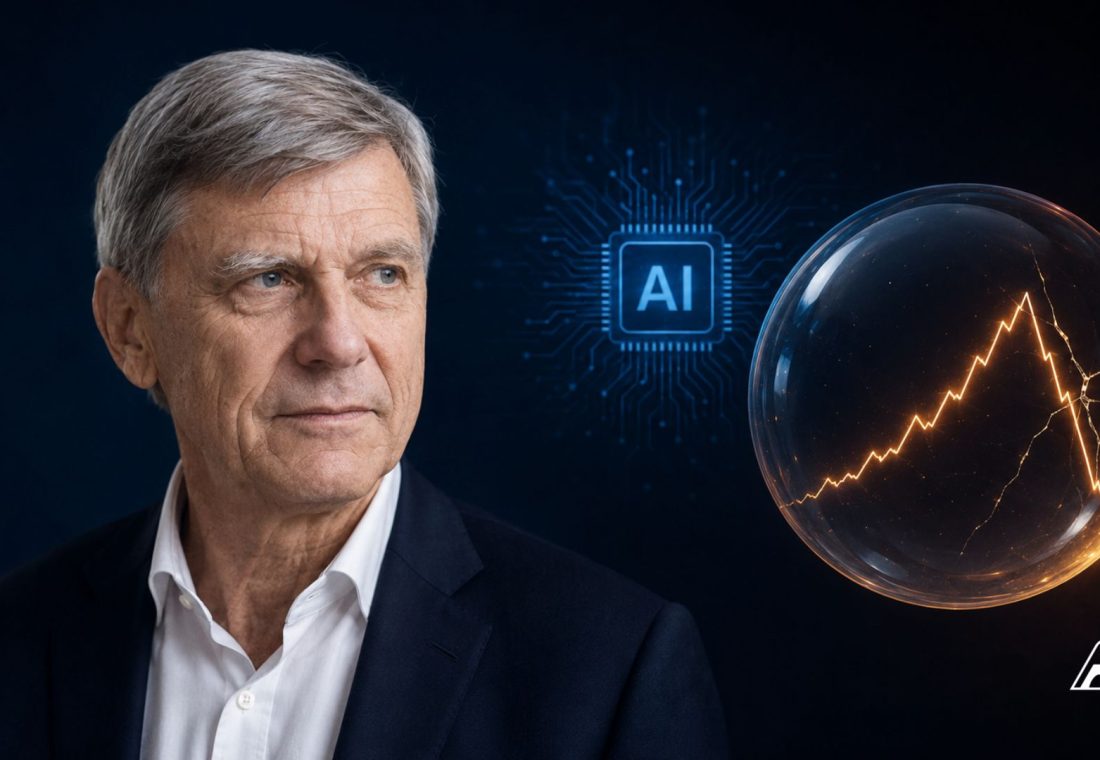

Hermann Hauser believes two things can be true at the same time: artificial intelligence can become one of the most important technology shifts in modern history, and parts of today’s AI market can still be priced like a bubble.
In an interview for CNBC’s The Tech Download, Hauser described the path ahead as a “rollercoaster”. CNBC’s summary says the veteran investor sees enormous long-term value in AI while warning that hype, valuations and the way the boom is financed deserve closer scrutiny.

Hauser co-founded Acorn Computers and played a pivotal role in spinning out ARM, according to Amadeus Capital, before becoming a long-time deep-tech investor.
Hauser Is Separating The Technology From The Valuation
The important distinction in Hauser’s argument is simple. A technology can change the world without every company attached to it deserving its current valuation.
That is roughly what happened during the internet boom. The internet survived and created enormous companies. Many dot-com stocks still collapsed because investors had paid for growth that never arrived.
Hauser is not making a blanket call that AI will repeat that exact pattern. His point is narrower: some valuations have moved faster than the underlying economics, while large financing commitments are making the sector more interconnected.
That debate is already visible across markets. Chinese hedge funds have warned that parts of the AI trade look like a “super bubble”, while the recent AI infrastructure financing push has raised fresh questions about who carries the risk if demand disappoints.
We think this is the most useful way to read Hauser’s warning. The question is not “Is AI real?” The better question is whether markets have priced the next decade of AI success too early.
Circular Financing Is Where The Risk Gets Harder To Ignore
One concern Hauser highlighted is circular financing. In plain English, that can involve an infrastructure company or hyperscaler investing in an AI lab while the lab also commits to buying compute from the same ecosystem.
The Bank for International Settlements has been examining this structure. A June 2026 working paper said major hyperscaler capital expenditure is set to exceed $700 billion in 2026 and warned that circular stakes can increase interconnectedness during a boom.

That does not mean every AI financing deal is circular, or that circular financing automatically causes a crash. But it can make the system harder to read because investment, customer demand and supplier revenue may reinforce one another. The BIS argues that debt and circular equity structures can amplify losses if an investment boom reverses.
The scale is already moving beyond traditional corporate spending. NVIDIA’s new Wall Street partnerships aim to mobilise more than $500 billion for AI infrastructure, while a separate look at the AI spending boom shows how leases, debt and future commitments are becoming part of the buildout.
For South African readers, the risk is mostly indirect. Changes in global cloud investment, financing costs or AI service pricing can eventually move downstream to businesses that depend on those platforms.
AI Could Force Another Computing Architecture Reset
Hauser’s argument is not only about finance. He also believes AI is pushing computing hardware toward a deeper architectural change.
AI systems need huge amounts of compute, memory bandwidth, power and cooling. Moving data between memory and processors can itself become a major cost, creating pressure for more efficient ways to build AI hardware.

Hauser pointed to in-memory computing and photonic computing as possible responses. In-memory computing performs more work close to stored data, while photonic systems use light for parts of computation or data movement.
That matters because Hauser has seen an architecture shift before. Arm built its position around efficient processor designs when power consumption became a crucial constraint. AI may now create another opening for hardware approaches that solve a new bottleneck.
A financial shakeout would not necessarily stop that engineering shift. It could instead force the industry to focus harder on efficiency, utilisation and real customer demand.
Europe’s Bigger Risk May Be Dependence
Hauser also returned to a long-running concern: technological sovereignty.
He argues that Europe produces strong science, startups and engineering talent but struggles to turn enough of those companies into global-scale technology leaders. His concern is that the continent becomes too dependent on foreign suppliers for critical technologies.
That concern travels beyond Europe. The more AI becomes infrastructure, the more important it becomes to ask who owns the models, chips, cloud capacity and software layers everyone else depends on.
Hauser’s warning is therefore not a prediction that AI is about to collapse. It is a reminder that a real technological revolution can still produce bad investments, fragile financing structures and painful corrections along the way.
Do you think the bigger AI risk is a valuation reset, or that the infrastructure boom becomes too important to unwind cleanly?
FAQs
Is Hermann Hauser saying AI is a bubble?
No. Hauser argues that AI can create enormous long-term value while some current valuations still become excessive. Technology success and investment losses can happen at the same time.
What is circular financing in the AI industry?
Circular financing happens when investment money flows into an AI company that then spends part of that capital within the investor’s technology ecosystem. The BIS says these structures can create stronger financial links between AI labs, hyperscalers and infrastructure providers. That interconnectedness can become more important if the boom suddenly reverses.
Why does Hauser’s warning matter outside the US and Europe?
AI infrastructure is increasingly global, so changes in spending or financing can affect cloud capacity, hardware investment and service pricing elsewhere. South African companies using global AI platforms may therefore feel some effects even without financing frontier models themselves. The important distinction is between AI adoption continuing and the financial terms around that adoption changing.