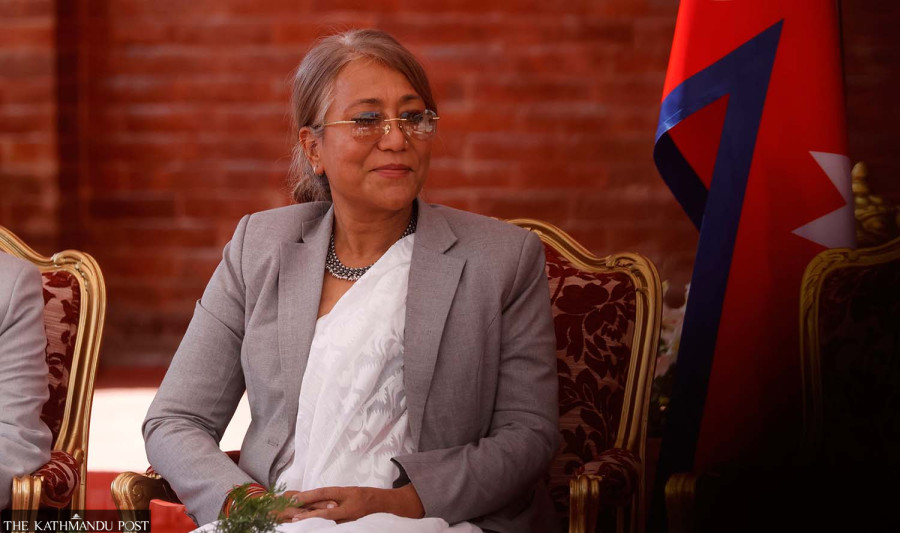
On Thursday, Chief Justice Manoj Kumar Sharma left for India on a four-day official visit following an invitation from his Indian counterpart, Surya Kant. Senior-most Justice Sapna Pradhan Malla saw him off at Tribhuvan International Airport, marking her first public appearance alongside Sharma since his appointment. During his absence, Malla assumed the responsibility of acting chief justice, taking charge of the Supreme Court leadership on Friday.
The warm send-off at the airport sparked speculation within legal circles about a potential reconciliation between the two top justices. Malla’s presence was viewed by some as an attempt to mend working relations and move forward together with Chief Justice Sharma.
Following Sharma’s appointment as chief justice, Malla went on a long leave and remained irregular upon her return, notably missing from the constitutional bench where she previously sat as a regular member.
Malla and Sharma’s strained relationship: From bench orders to airport send-off
Malla, the senior-most justice of the apex court, was in line to become Nepal’s second female chief justice after Sushila Karki. Historically, judicial tradition dictated that the senior-most justice succeeded the retiring chief justice.
The Judicial Council recommended a roster of six names, placing Malla at the top. She anticipated her nomination during the Constitutional Council meeting on May 7.
However, the Constitutional Council, chaired by Prime Minister Balendra Shah, bypassed the top three senior justices—Malla, Kumar Regmi, and Hari Prasad Phuyal—and recommended Sharma, who was fourth in seniority.
Speaker DP Aryal, Law Minister Sobita Gautam, and Deputy Speaker Rubi Kumari Thakur supported the prime minister’s proposal, while opposition party leader Bhishma Raj Angdembe and National Assembly Chairman Narayan Dahal filed written disagreements.
Critics argued this ‘pick-and-choose’ approach broke long-standing judicial conventions and undermined judicial independence. Writ petitions challenging the decision as unlawful faced administrative hurdles at the Supreme Court. The court administration rejected filings by senior advocates Dinesh Tripathi and Prem Raj Silwal, withholding formal refusal orders for days.
The dispute peaked on May 18, a day before Sharma’s parliamentary hearing. Petitioners submitted an application to Malla, who was then serving as acting chief justice, alleging that the administration was deliberately withholding orders to block judicial review. Malla issued a three-page order directing the administration to register the petitions by 1 pm that afternoon and schedule a hearing for the following day. Following her directive, key administrative staff, including the chief registrar and registrar, briefly went untraceable.
On May 19, the Parliamentary Hearing Committee unanimously endorsed Sharma. He took charge as the 33rd Chief Justice of Nepal. Displeased with being bypassed by a junior colleague, Malla took 20 days of approved leave. Justice Kumar Regmi welcomed Sharma to the court instead. Malla returned to her judicial duties on June 8.
During their tenure, actions taken by senior justices to stay certain government decisions fueled rumours of political pressure, including threats of impeachment or demands for resignation. Reports circulated within judicial corridors that the government pressured the three bypassed justices to resign, allegedly with Sharma’s backing. These rumours subsided when no formal motion was tabled. However, statements from three international human rights organisations expressing concern over political interference in the judiciary revived public debate on Friday.
The rift between Sharma and Malla also impacted the Judicial Council, stalling key judicial appointments across the Supreme Court, High Courts, and district courts. Tensions appeared to ease slightly on July 16, when Malla attended a Judicial Council meeting and agreed to the transfer of 50 High Court judges and 157 district court judges.
Has their relationship improved?
Speaking to Kantipur on condition of anonymity, five sitting Supreme Court justices presented differing views on whether relations between the top two apex court justices had truly improved. Some described Malla’s presence at the airport as a mere formal duty rather than a gesture of goodwill.
“The impeachment rumours have not completely vanished,” one sitting justice told Kantipur. “Simply seeing someone off at the airport or signing transfer decisions in the Judicial Council does not mean everything is resolved. We must wait and observe how upcoming judicial appointments, bench assignments, and constitutional bench rosters are managed in the coming days.”
Meanwhile, justices considered to be close to Chief Justice Sharma emphasised the necessity of unity to safeguard the institution.
“Internal division and personal friction among justices only weaken the judiciary,” another justice said. “Past precedents show that judicial instability harms the entire system. Justices must sit together, communicate openly with the chief justice, and work collaboratively under his leadership.”
When contacted for comment regarding the reported reconciliation with Sharma, acting Chief Justice Malla declined to comment. “I have no official statement to make on this matter,” she said.