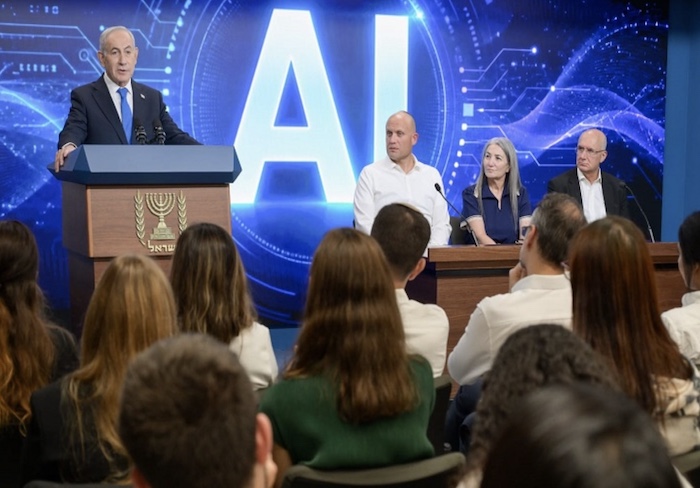

Israel has adopted a five-year national artificial intelligence strategy centered on expanding computing infrastructure, developing a domestic quantum computer, attracting leading global AI companies and researchers, and deploying AI across the economy and public sector.
The plan, announced last week week by Israel’s National Artificial Intelligence Directorate in the Prime Minister’s Office, sets a target of at least 100,000 advanced AI accelerators, beginning with an initial buildout of 5,000. It also calls for an advanced semiconductor fabrication facility in Israel using 5-nanometer technology or below, as well as a feasibility study for hosting AI computing infrastructure in low Earth orbit.

The financial commitment is substantial. The government has allocated NIS 3 billion for 2026 to promote AI in the economy and integrate the technology into government ministries. On July 9, National AI Directorate head Brig. Gen. (Res.) Erez Askal told the Knesset Subcommittee on AI and Advanced Technologies that implementing the broader plan would require approximately NIS 5 billion per year. A fully budgeted multiyear plan is expected to be completed by the end of 2026 for the 2027 state budget.
The strategy, formulated under Government Resolution 4255, is built around what the Directorate calls “Lived AI” — integrating artificial intelligence into public life and applying it to challenges in healthcare, education, government services, productivity and national security.
A key initiative is a National Institute for Impact-Driven AI Applications, which will establish five “acceleration reactors” — regional labs connected to existing centers of excellence and partnered with government or business leaders. The labs will focus on nine systemic goals and take AI solutions from development through national-scale deployment.
The government is also seeking to strengthen Israel’s position in AI security. New laboratories will be developed with the National Cyber Directorate to address threats targeting AI systems, building on the country’s established cybersecurity industry.
The strategy includes a National Ethics Council to advise on algorithmic transparency, fairness and privacy, alongside expanded AI research and education, improved access to data, efforts to attract researchers and deeper international cooperation on chips, computing and AI standards.
The 100,000-accelerator target is not a government purchase of 100,000 processors. The plan envisions the computing infrastructure being led by the private market, with the state supporting its development and serving as a major user.
Taken together, the strategy represents a broad push to build Israel’s AI ecosystem — spanning compute, quantum technology, chips, research, cybersecurity, regulation and deployment — backed by a funding requirement expected to reach billions of shekels annually.