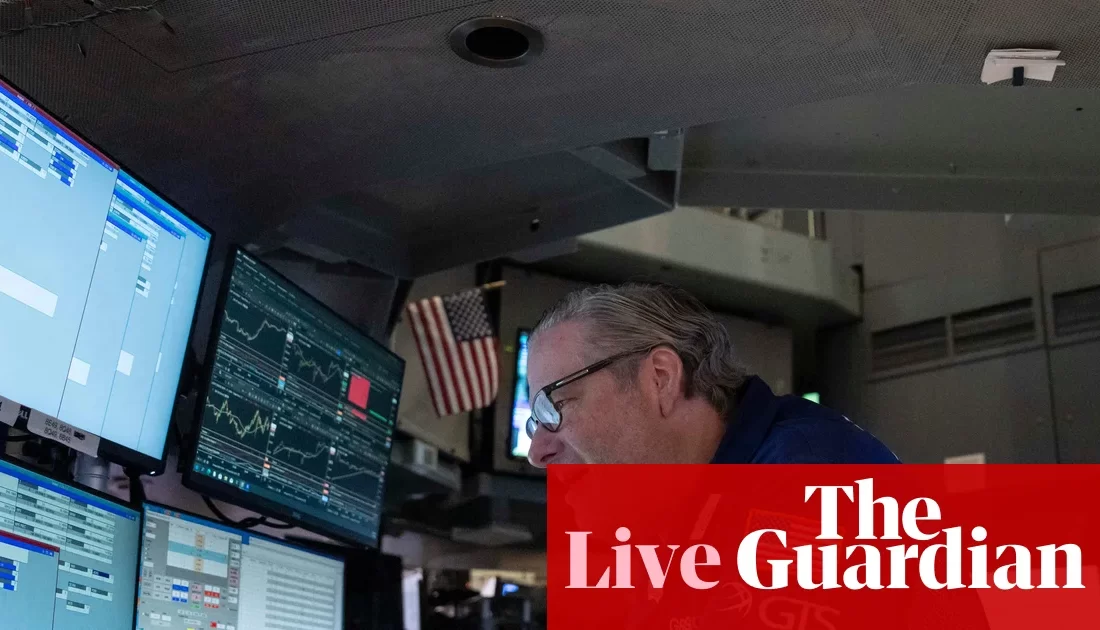


US Treasury bond yields tumble after Bessent steps in to calm market
US government bond yields have fallen sharply after Treasury secretary Scott Bessent stepped in, saying the department will more than double its government debt repurchases.
With global bond markets under pressure and yields surging to levels not seen in nearly two decades in recent days, the announcement brought some relief to the market.
The Treasury department will buy up more debt in the 10- to 20- year and 20- to 30-year sections of the market. The government will “at least double” the maximum size of its buyback operations, from $2bn to “at least” $4bn, the department said.
Yields plunged following the announcement while stock market futures rose sharply.
The benchmark 10-year bond fell 6 basis points to 4.647% while the 30-year “long” bond tumbled 9 basis point to 5.196%. (A basis point equals 0.01%. Yields move in opposite direction to prices.)
Neil Wilson, investor strategist at Saxo UK, said:
Call it the Bessent Put…Kevin Warsh’s Fed might not want to give forward guidance on rates but Treasury and Bessent clearly do!
We have seen huge move in bonds with the curve sharply flattening as the US Treasury announced upscaled buybacks to support the long end of the curve. It’s provided some immediate relief to the long end of the Treasury curve and eased some of the pressure building up lately.
This is probably more about the signal the administration wants to send to the market than the size of the operation – it’s small potatoes vs the $40tn US government debt. I see it as a very strong sign that the Treasury has decided higher US yields are unacceptable, and that the recent blowout in the long end is undesirable and needs counteracting by means other than a) raising short-term rates to re-anchor expectations or b) reining in fiscal drift. Clearly Donald is not happy yields have blow out…
Treasury said it is increasing, by at least double, the size of liquidity support buyback operations for longer-dated nominal coupon securities, ie across the 10-30 year range where buyers have been absent for at least a month.
These operations are a kind of mini- or quasi-QE by supporting prices and lowering yields, resembling Fed asset purchases albeit they don’t work the same way; the effect seems to be similar. It resembles Operation Twist by seeking to support the long end and improve liquidity, which could put more pressure on the USD if the market interprets this as meaning easier financial conditions because it allows the Fed to avoid a monetary policy response and implies official support for the Treasury market; or in essence fiscal dominance.
However, this might complicate the US Federal Reserve’s job, he said.
Federal Open Market Committee minutes coming up later…but if Kevin Warsh didn’t want to take signals from markets then how does this help? Clearly this clouds the picture for the Fed.
Key events
Closing summary
US government bond yields tumbled from multi-decade highs after the Treasury department stepped in to calm the market, saying it would “at least” double its debt repurchases.
George Saravelos, currency strategist at Deutsche Bank, said:
In an unexpected announcement, the US Treasury announced a big increase in buybacks of long-end US Treasuries. The dollar is weakening unusually sharply. Why? We make the following observations:
First, we see the unexpected buyback announcement as well as the discouragement of intervention from Japan earlier this month as signs of increasing administration unease on the ongoing rise in long-end US yields.
Second, we see both the buyback and encouragement to use the FIMA [Foreign and International Monetary Authorities] facility for FX reserves as soft-form financial repression policies aimed at containing the long-end of the US yield curve.
Third, we see both developments as negative for the dollar. If the market price of USTs is not “allowed” to adjust down, the foreign exchange price of UST owned by foreign investors has to adjust via a weakening in the dollar.
Fourth, the buyback operation is effectively very similar to the Fed’s operation twist. Treasury would have to issue more treasury bills to finance the removal of duration from the market. To the extent that this eases financial conditions, it would arguably necessitate an offsetting tightening from the Federal Reserve. If Chair Warsh does not recognize the buyback as a factor driving an easing of financial conditions, we would take it as an additional dollar negative driver.
In all, the market is likely to be increasingly attentive to further measures intended to support the US Treasury market going forward. The more these are perceived as distortionary to market pricing, the more the dollar is likely to weaken.
UK inflation rose to 2.9% in July as the impact of the Iran war on energy prices triggered a renewed cost of living squeeze for British households.
Thank you for reading. We’ll be back tomorrow. Take care out there! – JK
Moderna shares more than doubled on news of its skin cancer drug breakthrough in a late-stage clinical trial, jumping 120% after Wall Street opened.
They are now trading at $124.88, roughly double what they were worth yesterday.
The mRNA-based shot, intismeran, given in combination with US drugmaker Merck’s immunotherapy Keytruda (also known as pembrolizumab), met key goals in the Phase 3 trial in 1,137 patients with higher-risk or advanced melanoma whose detectable cancer had been completely removed through surgery.
Professor Georgina Long, the study’s principal investigator and medical director of Melanoma Institute Australia, said:
Today’s results represent a landmark moment for adjuvant melanoma treatment.
Intismeran in combination with pembrolizumab has the potential to establish a new treatment paradigm in the adjuvant melanoma setting, helping patients remain cancer-free for longer.
Moderna chief executive Stéphane Bancel said in an interview on CNBC’s Squawk Box:
It’s a big moment for medicine, a big moment for patients.
The company explained:
Intismeran is designed and produced using a patient’s tumor sample to identify the unique mutational signature, or “fingerprint,” of their cancer and generate an anti-tumor immune response. Each therapy consists of a synthetic mRNA coding for up to 34 neoantigens [abnormal proteins that form on the surface of cancer cells due to tumor DNA mutations and act as red flags] and is tailored to the unique biology of an individual patient’s tumor.
Upon administration, the RNA-encoded neoantigen sequences are translated in the body and presented to the immune system, a key step in generating specific T-cell responses against cancer cells. Individualized neoantigen therapies are designed to train and activate an anti-tumor immune response based on the unique mutational signature of a patient’s tumor.
Markets understood the message immediately, said Stephen Innes, global strategist at Bangkok-based Quintex Intel. Long bonds rallied and the 30-year yield fell as much as 9 basis points to around 5.19%.
This is not QE, and it is not the Fed cutting rates. Treasury is buying older securities to improve market liquidity rather than attempting to engineer a broad easing of financial conditions. But for traders, the distinction only gets you so far when the intervention arrives directly after long yields hit multi-decade highs.
Scott Bessent had previously described Treasury’s buyback program as part of a broader toolkit available if bond-market dislocations became problematic. Wednesday was the first meaningful indication that Treasury is prepared to use more of that toolkit when duration starts misbehaving.
John Briggs at Natixis captured it neatly: the timing is unlikely to be an accident. If yields move too far, Treasury will try to fight the disorder, and the market now has a better idea where some of those pain points sit.
That matters enormously for equities, Innes said.
The latest selloff in technology has been driven as much by the denominator as the numerator. When the 30-year is above 5.3% and real yields are climbing, long-duration equity valuations get compressed whether the earnings story has changed or not. Semiconductors and the higher-beta AI complex were therefore sitting directly in the firing line.
A Treasury-induced rally in long bonds removes some of that pressure. Hence the rebound in stocks.
But there is an important distinction between containing a disorderly move and reversing the macro forces behind it.
Treasury buybacks do not eliminate heavy government issuance. They do not remove the fiscal premium. They do not make $90-plus oil disappear, and they do not solve the enormous financing requirements sitting behind the AI capital-expenditure boom.
What they do is tell the market that Washington does not want the long end becoming completely unhinged.
That changes the trading calculus.
Until Wednesday, traders were testing how high long yields could go before something cracked. Now they know Treasury is watching the same levels.
And once the market knows there is a pain threshold, it starts trading the threshold.
Treasury may not have put a hard ceiling on yields, but Bessent just showed traders where the roof begins to creak.
The accelerated buyback will start on 9 September and run until 4 November.
The US Treasury department said:
This increase in buyback operation sizes reflects Treasury’s desire to provide greater liquidity support in longer-dated nominal sectors where there is consistent strong sponsorship from market participants, as evidenced by the significant volume of high-quality offers Treasury routinely receives in longer-dated buyback operations.
This means that the Treasury will buy more longer-duration debt, in an attempt to calm nerves and steady the market.
US Treasury bond yields tumble after Bessent steps in to calm market
US government bond yields have fallen sharply after Treasury secretary Scott Bessent stepped in, saying the department will more than double its government debt repurchases.
With global bond markets under pressure and yields surging to levels not seen in nearly two decades in recent days, the announcement brought some relief to the market.
The Treasury department will buy up more debt in the 10- to 20- year and 20- to 30-year sections of the market. The government will “at least double” the maximum size of its buyback operations, from $2bn to “at least” $4bn, the department said.
Yields plunged following the announcement while stock market futures rose sharply.
The benchmark 10-year bond fell 6 basis points to 4.647% while the 30-year “long” bond tumbled 9 basis point to 5.196%. (A basis point equals 0.01%. Yields move in opposite direction to prices.)
Neil Wilson, investor strategist at Saxo UK, said:
Call it the Bessent Put…Kevin Warsh’s Fed might not want to give forward guidance on rates but Treasury and Bessent clearly do!
We have seen huge move in bonds with the curve sharply flattening as the US Treasury announced upscaled buybacks to support the long end of the curve. It’s provided some immediate relief to the long end of the Treasury curve and eased some of the pressure building up lately.
This is probably more about the signal the administration wants to send to the market than the size of the operation – it’s small potatoes vs the $40tn US government debt. I see it as a very strong sign that the Treasury has decided higher US yields are unacceptable, and that the recent blowout in the long end is undesirable and needs counteracting by means other than a) raising short-term rates to re-anchor expectations or b) reining in fiscal drift. Clearly Donald is not happy yields have blow out…
Treasury said it is increasing, by at least double, the size of liquidity support buyback operations for longer-dated nominal coupon securities, ie across the 10-30 year range where buyers have been absent for at least a month.
These operations are a kind of mini- or quasi-QE by supporting prices and lowering yields, resembling Fed asset purchases albeit they don’t work the same way; the effect seems to be similar. It resembles Operation Twist by seeking to support the long end and improve liquidity, which could put more pressure on the USD if the market interprets this as meaning easier financial conditions because it allows the Fed to avoid a monetary policy response and implies official support for the Treasury market; or in essence fiscal dominance.
However, this might complicate the US Federal Reserve’s job, he said.
Federal Open Market Committee minutes coming up later…but if Kevin Warsh didn’t want to take signals from markets then how does this help? Clearly this clouds the picture for the Fed.
Rising inflation underlines scale of Andy Burnham’s cost of living challenge
Back to our main story, the rebound in UK inflation on the back of higher household energy bills.
Rising inflation underlines the scale of Andy Burnham’s cost of living challenge, writes our economics editor Heather Stewart in her analysis of today’s inflation data.
July’s increase in inflation, to 2.9%, is likely to be the first of several, underlining the challenge facing Andy Burnham in shielding consumers from a fresh cost of living squeeze this autumn.
Rising energy bills, as an increase in Ofgem’s quarterly price cap came into force, were the main driver of the jump in inflation, from 2.6% in June. That was partly offset by cheaper fuel prices – the knock-on effect of hostilities easing in the Middle East, after Donald Trump hailed his “memorandum of understanding” with Iran in June.
However, fuel prices have risen again in recent weeks as hopes of a permanent end to the conflict have faded, and the Ofgem price cap for household energy bills in Great Britain is expected to rise by 4% in October.
Burnham’s early decision as prime minister to cut VAT from electricity bills will help to ease the pressure on budgets, but it risks being overwhelmed by wider price rises.
Food prices have been remarkably quiescent so far in the face of the conflict, rising at an annual rate of only 1.3% in July, down from 1.7% a month earlier. But it is likely there is worse to come, as a result of extreme heat and drought through the summer months.
Forecast energy price cap rise in Britain could push UK fuel bills up 4% this winter
Household energy bills across Great Britain are expected to climb to a three-year high this winter as the impact of the Middle East war wipes out Andy Burnham’s tax cut on electricity bills.
The government’s cap on energy prices is on track to rise by 4% from this October to the equivalent of £1,729 a year through the last three months of 2026, which could hit struggling households especially hard this winter, according to analysis by the energy consultancy Cornwall Insight.
The forecast quarterly price cap would be the highest since July 2023, after soaring energy market prices from the Middle East were compounded by the increased use of expensive gas in power plants during heatwaves across Europe.
The rising cost of gas will more than offset the new prime minister’s promise to cut VAT from household electricity bills from October, which aimed to give voters “some breathing space” on living costs by shrinking bills by an average of £45 a year.
Dog food recalled after reports of pets losing their sight
A dog food brand has recalled all of its fresh meals after reports that a recipe change may have caused some animals to develop an eye condition that, if left untreated, can lead to sight loss.
The brand Years said owners should stop feeding its fresh meals to their dogs “immediately” and also told them not to feed the meals to any other animal, or to donate or sell them.
In response to reports from some owners of pets not responding to treatment and in some cases losing their sight, Years told the Guardian:
The picture is mixed. Some [ophthalmologists] report dogs responding well to treatment … others have seen limited or slower responses.
The firm runs a subscription-based service delivering “personalised” meals and its products are also available at some retailers including Pets at Home.
Years said that as of the early hours of Wednesday, it had had 192 customers report “potential, yet unverified, eye issues” out of roughly 40,000 customers. It previously said that as of Sunday it had “received 57 suspected cases” of the condition, known as sudden bilateral dry eye.
Axel Rudolph, chief technical analyst at investing and trading platform IG, has looked at why Moderna’s skin cancer vaccine breakthrough has sent its shares soaring – now up 90% in pre-market trading.
Moderna has delivered the breakthrough investors have been waiting for, with its personalised mRNA melanoma vaccine producing a positive Phase III result and becoming the first mRNA cancer therapy to clear a late-stage trial.
The vaccine helped patients stay cancer-free for longer and showed that mRNA treatments could work against cancer, not just infections. The shares were already up strongly this year, but today’s [share] surge reflects the possibility that melanoma could prove to be the platform’s pivotal proof of concept. There are still important questions around the size of the benefit and overall survival, but this is a major milestone that could transform Moderna’s longer-term growth story.
Chinese carmaker Chery plots UK expansion with major R&D centre
Alex Daniel
The Chinese carmaker behind the irreverently nicknamed “Temu Range Rover” is plotting further UK expansion with a major research and development centre in England.
Chery, which makes the Jaecoo and Omoda car brands, said the launch of a new R&D site was “the next step in our long-term plan” for Britain as it also moves towards manufacturing its cars in the UK.
Chery’s sales are growing at breakneck pace in Britain. In July, the Chery, Omoda and Jaecoo brands accounted for nearly 8% of UK market share, up from 3% last year, according to the Society of Motor Manufacturers and Traders.
The Jaecoo 7, a hybrid electric built in China known as the “Temu Range Rover” for its low price and techy add-ons, became the top-selling model in the UK in March, but Chery currently has to bring them in from abroad.
The company is part-owned by the Chinese state, and has already signed a deal with Nissan to build its cars at its Sunderland plant, in a move that would begin mass-market Chinese car production in Britain for the first time from 2027.
The new R&D facility will open in late autumn, Chery said on Wednesday. Gary Lan, chief executive of its UK business, said:
We waited over 20 years for the right time to enter this market, and our ambition has always gone much further than simply bringing vehicles here.
An existing vehicle testing centre between Bedford and Milton Keynes that is used by engineering and motorsport companies – as well as the Ministry of Defence – will be the site of Chery’s new R&D facility.
The centre, called UTAC Millbrook, will give Chery access to more than 70 kilometres of purpose-built test tracks for it to fine tune its cars for UK roads. Further down the line it will also use the site to work on self-driving cars and artificial intelligence.
Moderna shares surge after personalized cancer vaccine success

Graeme Wearden
Over on Wall Street, shares in US biotech company Moderna have surged almost 60% in pre-market trading after reporting positive trial results from its personalised mRNA cancer vaccine for melanoma.
Moderna and US pharma group Merck say they have achieved “positive topline results” for a phase three trial of their individualized neoantigen therapy and mRNA-based cancer therapy on patients with melanoma.
Known as mRNA-4157 (V940), the vaccine targets tumour neoantigens, which are expressed by tumours in a particular patient. These are markers on the tumour that can potentially be recognised by the immune system
“Today’s results represent a landmark moment for adjuvant melanoma treatment,” said Professor Georgina Long, the study’s principal investigator and medical director of Melanoma Institute Australia, Chair of Melanoma Medical Oncology and Translational Research at the University of Sydney.
The phase 3 trial began in 2024, after an earlier trial found the vaccines dramatically reduced the risk of the cancer returning in melanoma patients.