

Key takeaways
- Scaling social media content means building systems that increase output without sacrificing quality, not just posting more often.
- Enterprise teams scale effectively by combining shared content libraries, clear approval workflows, content repurposing, and AI-powered tools.
- Measuring what works, and cutting what doesn’t, is essential to scaling sustainably without burning out your team.
- Hootsuite Social OS connects content creation, publishing, approvals, analytics, and AI orchestration in one governed system built for enterprise scale.
Scaling social media content means building a system that lets your team create more content without losing quality.
It’s what big brands depend on when they need to post quickly, in different locations, across different platforms, while still feeling like one unified brand. It also relies heavily on content repurposing, so one strong idea can power many posts instead of starting from scratch each time.

How scaling content differs from posting more often
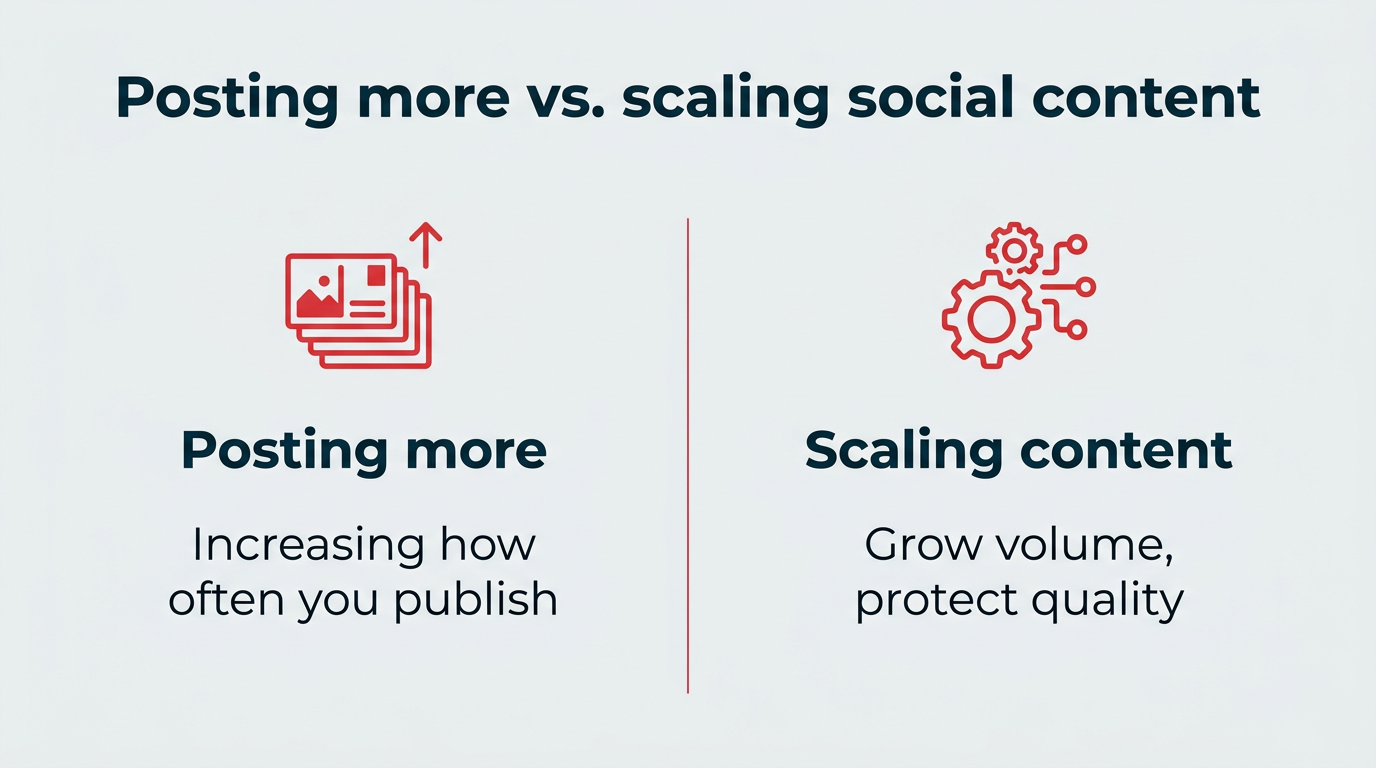
Scaling content isn’t the same as simply posting more often. Posting more often is about volume.
Scaling is about building a system that lets you create that extra volume without stretching your team, lowering quality, or creating chaos.
Here’s the difference in simple terms:
- Posting more: Increasing how often you publish.
- Scaling content: Improving how your team creates, reviews, stores, approves, and shares content, so you can increase volume and maintain brand consistency.
Enterprises scale content effectively when they:
- Support multiple regions and languages
- Keep brand identity consistent across social media platforms
- Handle high content demand for campaigns, user-generated content (UGC), influencers, and paid advertising seamlessly
- Build strong workflows and approval systems to make posting easy and safe
- Use automations (like content calendars, shared libraries, and approval workflows) to reduce manual work
Enterprises need to scale social media content so they can stay consistent, move faster, and keep quality high as the brand grows.
Here are a few of the most important reasons for scaling enterprise social media.
Managing volume and consistency across platforms and regions
Enterprise brands publish a huge amount of content, and each region has its own audience, rules, and needs. Without a scalable system, teams end up creating content from scratch, repeating work, or producing posts that don’t match the brand.
Scaling solves this by giving teams shared tools and guidelines. It helps to:
- Keep tone and brand identity consistent
- Adapt content for different cultures and time zones
- Publish across many social media platforms without mistakes
- Avoid duplicate or conflicting content
- Make sure every team works from the same source of truth
The result is social media posts that always feel like “the brand,” no matter where they are published.
Driving brand impact and agility at scale
Social media moves fast, and large brands need systems that help them keep up without losing their voice. With more than 5.17 billion people using social platforms and users spending an average of 2 hours and 21 minutes a day scrolling, competition for attention is nonstop.
Fast responses now matter more than ever. According to Hootsuite’s Social Trends data, customers now expect brands to react to culture and conversation in real time.
But reacting fast is almost impossible for large brands without a system in place.
Scaled teams stay quick by watching what their audience is talking about, from trending topics to changes in how people feel. When they spot something early, they can update a post, reuse an existing piece of content, or answer a customer before the moment passes. This kind of fast response shows people the brand is paying attention.
Pro tip💡: Nest, the customer care app inside Hootsuite Social OS, helps teams spot questions, complaints, and fast-moving conversations the moment they happen.
Reducing inefficiencies with centralized workflows
Without centralized workflows, the enterprise content creation process gets messy fast. Teams may store assets in different places, follow different processes, or rely on manual approvals that slow everything down.
Content scaling fixes these issues by providing:
- One place to store brand-approved assets
- Shared templates and branded content formats
- Clear approval and permission systems
- Automation for publishing and scheduling
- Analytics that show what’s working and what needs attention
When teams stop reinventing the wheel, they get more time back. Plus, the content production is more consistent and easier for the whole organization to use.
To scale content creation, businesses need a setup that helps teams make more diverse content easily. That means knowing where ideas live, how posts get made, who approves them, and how they go live across all your social channels.
Here’s a quick view of all nine steps before the detailed breakdown:
- Build a shared content library
- Set clear approval workflows
- Use templates to make creation faster
- Repurpose content across formats and channels
- Use automation for repeatable tasks
- Support local teams with clear guardrails
- Leverage user-generated content and creator partnerships
- Let analytics guide what you scale
- Build a culture that supports scaling
1. Build a shared content library
A shared content library is the home base for every piece of content your teams produce. It gives every content team the same starting point, instead of everyone making their own version from scratch.
A strong content library includes:
- Brand-approved images and video
- Post templates for each social platform
- Saved captions and messaging examples
- Design files for common formats like Instagram Reels, Stories, or carousels
- Local variations that regions can adapt
- A backlog of content ideas your team can pull from when timelines get tight
- Brand style guides and voice and tone guidance
In Hootsuite Social OS, Perch brings content, planning, and publishing together, so global teams find what they need fast and stay on-brand without extra back-and-forth.

2. Set clear approval workflows
Approvals are how you scale without worrying something risky will slip through. They keep posts on-brand and, in regulated industries, compliant.
A clear approval workflow spells out:
- Who drafts and edits posts
- Who approves them for each region or brand
- When legal or compliance needs to review
- How urgent posts get fast-tracked
- Where final approval happens before publishing
Kevin Johnson, Global Social Media Manager at Talent Systems, suggests formalizing your process so you don’t get trapped in endless review cycles.
“An enterprise license for a suite like Hootsuite is usually the biggest difference maker. They solve your scheduling, content banks, and most approval headaches in one place,” says Johnson.
Johnson adds, “And I swear this isn’t an ad!” He also uses RACI rules to keep projects moving.

3. Use templates to make creation faster
Templates help teams make good content quickly. They help individual regions produce high-quality content, even on tight timelines, and give structure so people don’t have to start from a blank page.
Useful social media templates can include:
- Post layouts for each social network
- Reels, TikTok, and short video formats
- Caption starters and hashtag sets
- Graphics and infographics for recurring series
- Campaign frameworks that regions can plug into
Johnson says templates are key to how big teams stay consistent. “Ask your designers to build modular templates for all your routine stuff: quotes, tips, awards, testimonials. This makes those assets basically plug-and-play,” explains Johnson. “It frees up their time for the high-priority, custom campaign work.”
Pro tip💡: If you don’t have templates yet, borrow from trusted sources while you build your own library. The Hootsuite blog has 250+ free templates your team can make use of.
Many creators also offer great starter packs, including Taylor Loren. Sites like Figma, Creative Market, and Canva’s template library also offer strong options for teams that need polished templates right away.
4. Repurpose content across formats and channels
Content repurposing is one of the fastest ways to scale, because it lets you turn one strong idea into many platform-ready assets. Instead of creating everything from scratch, your team gets more mileage out of the work it has already done, while keeping a consistent message across channels.
Common ways enterprise teams repurpose content include:
- Turning a blog post into an Instagram carousel or a LinkedIn document post
- Cutting webinar or event recordings into short Reels, TikToks, and Shorts
- Reworking a customer story into a quote graphic, a video clip, and a caption
- Adapting one campaign message into platform-specific formats and aspect ratios
- Refreshing top-performing posts from last year with new data or visuals
AI makes this even faster. Perch’s AI-assisted content creation inside Hootsuite Social OS can help teams rewrite, resize, and reframe a single asset for different channels in minutes, so repurposing becomes part of the workflow rather than an afterthought.
5. Use automation for repeatable tasks
Automation is how you scale without asking your team to work 24/7. It should streamline the repetitive work, not the human parts.
Automation can help you:
- Schedule batches of posts ahead of time
- Publish at best times based on past performance
- Line up posts across time zones and regions
- Get alerts when key topics or hashtags spike
- Reuse existing content that performs well
Don’t overlook tools that could save hours, says Johnson. “I’ve seen teams ignore tools they already pay for. If your organization has something that automates scheduling or approvals, use it,” says Johnson. “Making your life easier shouldn’t be a heroic effort.”
Features like Hootsuite bulk scheduling and best time to publish take the guesswork out of timing. And Wisdom, the AI orchestration layer inside Hootsuite Social OS, connects those governed workflows across apps, so your team can focus on the content itself.

6. Support local teams with clear guardrails
Global brands need content that feels local but still looks and sounds like the same brand. According to Deloitte, 75% of consumers are more likely to purchase from brands that deliver personalized content.
That means teams need the freedom to tailor posts for local culture, language, and audience needs, but within clear guardrails that keep brand awareness and integrity strong.
To support that, enterprise teams should give regions:
- Shared assets they can adapt for local markets
- Simple brand voice and tone guidelines
- Rules for what must not change (logos, claims, disclaimers)
- Space for local holidays, culture, and customer needs
- Guidance on local posting times and formats that perform well
This balance lets local teams move fast while still protecting brand identity.
7. Leverage user-generated content and creator partnerships
User-generated content and creator partnerships let enterprise brands scale output without a matching increase in internal production — with U.S. influencer marketing spending surpassing $10 billion and 15.7% growth expected in 2026, these partnerships are a proven scaling lever. Customers, employees, and creators become an extension of your content team, adding authenticity that in-house content often can’t match.
Ways enterprise teams scale with UGC and creators:
- Build creator briefs and templates so partners produce on-brand content consistently
- Set up clear rights management so you can legally reuse UGC across channels
- Create governance rules that protect brand safety when amplifying outside content
- Run employee advocacy programs to turn your team into a trusted content source
- Curate and repurpose the strongest UGC into campaigns and ads
Parliament, the employee advocacy app inside Hootsuite Social OS, is a natural scaling lever here. It gives employees pre-approved content to share, which extends reach while keeping messaging consistent and compliant.
8. Let analytics guide what you scale
You don’t want to scale everything, just what works. So, pay attention to your analytics so you can tie content directly to business goals.
Enterprise teams should consider the following when choosing which content to scale:
- Which formats get the strongest engagement
- Which posts help key goals like clicks or sign-ups
- Which regions or channels need more support
- When audiences are most active
- Which themes or series keep people coming back
This kind of insight improves your content planning so teams aren’t guessing what to make, build, or post next.
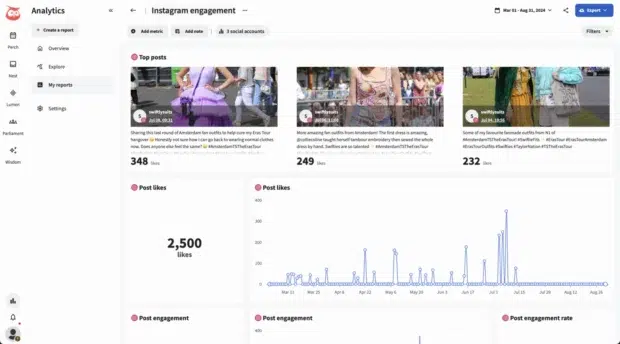
Metrics should guide what you scale, not instinct. Hootsuite Analytics pulls all of your social media marketing data into clear dashboards so social and leadership teams can see what to make more of, and what to reduce.
9. Build a culture that supports scaling
Tools and workflows matter, but culture plays a huge role in whether scaling actually works. Teams need shared habits and expectations that support fast, consistent content creation.
Strong scaling culture includes:
- Clear communication between global and local teams
- Respect for shared guidelines
- A willingness to reuse and adapt content, not rebuild it
- Openness to automation and AI support
- A shared commitment to brand consistency
Johnson argues that protecting your team’s focus is also part of scaling well.
“You have to start saying no to requests that don’t align with your core social media strategy. Say no to legacy content that performs poorly. Say no to new ideas just because everyone else is doing it,” says Johnson.
“Your team’s bandwidth is finite. Lean into your data and ask, ‘Why are we doing this?’ If the data doesn’t back it up, stop.”
This mindset shift pays off across your entire digital marketing ecosystem.
Use this checklist as a quick reference for the system behind all nine steps:
| Check | What you need | Why it matters |
|---|---|---|
| ◻ | Centralized content strategy and governance | Gives every team the same rules to follow so content stays on-brand. |
| ◻ | Approval workflows and role-based permissions | Keeps content safe, compliant, and reviewed by the right people. |
| ◻ | Content library and asset management system | Helps teams find and reuse approved images, videos, and templates. |
| ◻ | Collaboration tools for distributed teams | Lets global teams share ideas, update drafts, and stay aligned. |
| ◻ | Localization workflows and translation support | Helps regions adapt content for culture, language, and timing. |
| ◻ | Automation and AI tools for scheduling and insights | Saves time, reduces manual work, and improves posting accuracy. |
| ◻ | Standardized templates and publishing guidelines | Makes posts consistent across platforms while speeding up creation. |
| ◻ | Measurement framework for performance at scale | Shows what types of content work, what needs improvement, and where to invest next. |
| ◻ | Clear content ownership and team roles | Removes confusion about who creates, edits, approves, and publishes. |
| ◻ | A single source of truth for brand style and voice | Keeps brand identity solid across all social media platforms. |
The most common challenges when scaling social media content are the friction points that slow teams down as volume rises. Knowing them ahead of time helps you build a system that avoids them.
- Approval bottlenecks: Slow, unclear review cycles stall publishing. Fix them with the clear approval workflows in step 2.
- Brand inconsistency across regions: Local teams drift off-brand without guidance. Shared assets and guardrails (step 6) keep everyone aligned.
- Quality erosion at volume: More posts can mean weaker content. Templates and repurposing (steps 3 and 4) protect quality as output grows.
- Team burnout: Volume demands wear teams down. Automation (step 5) and a culture of saying no (step 9) protect bandwidth.
- Tool fragmentation: Scattered apps break workflows and version history. A connected system that centralizes work solves this, as covered below.
Each of these challenges is manageable when your social media workflow is built around governed, connected systems rather than one-off fixes.
How do you measure the success of scaled content?
You measure the success of scaled content by tracking metrics that tie output to real business outcomes, not just surface-level engagement. As volume grows, the goal is to prove that more content is also driving more value.
Vanity metrics tell you a post got seen. Business-impact metrics tell you whether your scaling strategy is actually working. Here’s how they compare:
| Vanity metrics | Business-impact metrics |
|---|---|
| Likes and reactions | Content velocity (volume published per cycle) |
| Impressions | Cost per content asset |
| Follower count | Time-to-publish (idea to live) |
| Raw view counts | Engagement rate per post |
| Total post count | Conversion contribution (leads, sign-ups, sales) |
When measuring content velocity and cost per asset, the aim is efficiency: are you producing more without spending more per piece? Pair those operational metrics with outcome metrics like conversions to show leadership the return on scaled content.
Lumen surfaces the insights and listening signals that tell you what’s resonating, while Hootsuite advanced analytics turns performance across markets into reports leadership can act on. Together, they help you keep scaling what works and cut what doesn’t.
AI helps enterprise teams scale social content in 2026 by speeding up the repeatable parts of the workflow, from drafting to reporting, so teams can produce more without adding headcount.
With 40% of enterprise apps featuring AI agents by end of 2026, up from less than 5% in 2025, this shift is becoming standard infrastructure. Used well, it removes friction while keeping humans in charge of strategy and voice.
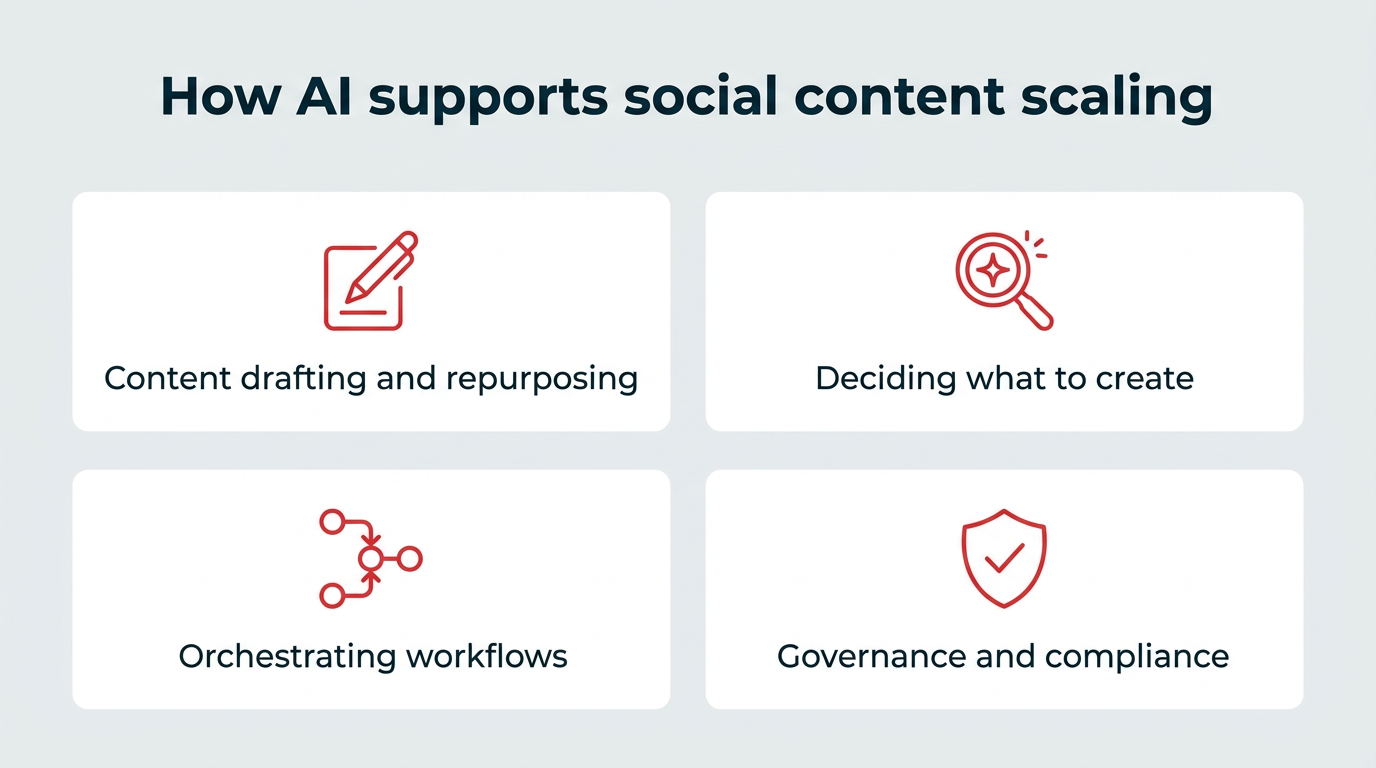
Practical ways AI supports scaling include:
- Content drafting and repurposing: Perch’s AI-assisted creation drafts, rewrites, and resizes content for different channels.
- Deciding what to create: Lumen uses AI-powered insights and listening to surface trends and topics worth acting on.
- Orchestrating workflows: Wisdom connects governed workflows across apps, coordinating scheduling, routing, and approvals.
- Governance and compliance: With 78% of consumers saying AI content labeling is critical to trust, Vigil helps keep AI-assisted content on-brand and compliant before it goes live.
Inside Hootsuite Social OS, these capabilities work together as intelligence in motion, so social media automation and AI orchestration support scale without sacrificing governance or quality.
Large teams can’t scale social by juggling a dozen apps. They need tools that help everyone work from the same place, follow the same rules, and move quickly.
Here are the types of tools most enterprise teams rely on:
- Content libraries: Store brand-approved images, videos, templates, and messaging.
- Workflow and approval tools: Keep publishing safe and consistent.
- Scheduling and automation tools: Handle large volumes of posts.
- AI-powered creation tools: Speed up writing, repurposing, and editing.
- Collaboration platforms: Connect global and regional teams.
- Analytics dashboards: Show what’s working at scale.
- Localization and translation tools: Adapt content for different markets.
- Digital asset management (DAM) systems: Keep brand files organized.
- MCP connectors: Link your social operating system to the rest of your enterprise stack for connected, governed workflows.
These systems also make it easy for freelancers or contractors to plug into your workflows without slowing things down. And they become even more powerful when they work together in one place.
Hootsuite Social OS brings all the pieces of enterprise social together in one connected system. Teams get a single social operating system for planning, creating, approving, and publishing content, which means fewer bottlenecks and a lot more consistency.
Here’s how the Hootsuite Social OS apps support scale:
- Perch: A shared content library, templates, planning, and bulk scheduling for packed multi-channel calendars.
- Lumen: AI-powered insights and listening to guide what to scale.
- Nest: Customer care at scale, keeping conversations on track across channels.
- Wisdom: AI orchestration that connects approval workflows and automation across apps.
- Vigil: Governance and compliance, plus role-based permissions to protect accounts and reduce mistakes.
- Parliament: Employee advocacy that extends reach as a scaling lever.
- Localization: Language features so regions can adapt content quickly.
Enterprise teams also rely on Hootsuite because it fits neatly into their wider tech stack. It works with DAM systems, CRM tools, compliance tools, and AI assistants, and MCP connectors extend those connected systems even further.
That means content doesn’t get stuck in someone’s inbox. It moves from idea to draft to approval to publishing without switching tabs or losing version history.
For organizations with strict governance or high content demand, this kind of integration removes friction and helps the whole company scale together.
Scale social media content across every team, region, and channel with Hootsuite Social OS. Plan, create, approve, and publish from one governed system, with AI-powered insights and orchestration built for enterprise scale.
What does it mean to scale social media content?
Scaling social media content means creating more posts without letting quality slip. It gives big teams a way to stay active across platforms and regions while keeping everything on-brand. With a strong system in place, your content marketing team has a solid base they can build on, especially when they need campaigns that grow across different markets.
What is scaling in social media?
Scaling in social media means building a sustainable system that lets your team grow its presence across platforms and regions without a proportional increase in resources or a drop in quality. It relies on shared libraries, clear workflows, repurposing, and AI to do more with the same team.
How can enterprises maintain quality while scaling?
Enterprises maintain quality while scaling when teams work from the same playbook. Shared templates, clear approval workflows, and simple brand guidelines keep posts consistent even as volume rises. When those pieces are in place, teams can optimize content quickly instead of starting from scratch every time.
What tools are best for scaling social media content?
The best tools for scaling social media content support the full process, not just publishing. A content library keeps assets in one place, and a scheduling platform makes it easier to plan ahead. Approval systems and AI creation tools like Perch and Wisdom help teams move faster, while analytics dashboards show what’s working so you can adjust in real time. Together, they keep big teams organized and aligned.
How does content repurposing help scale social media?
Content repurposing helps scale social media by letting teams turn one piece of content into multiple platform-specific assets, reducing production time while maintaining a consistent message across channels. A single blog post can become a carousel, a short video, and a series of quote graphics, so one idea does far more work.
How does automation help with scaling content?
Automation helps with scaling content by taking care of the jobs that eat up time, like scheduling, publishing, tagging, and reporting. When those tasks run in the background, teams get more space to focus on creative ideas and long-term strategy. Wisdom, the AI orchestration layer in Hootsuite Social OS, connects those tasks across apps so workflows stay governed.
What role does AI play in scaling social media content?
AI plays a growing role in scaling social media content by accelerating drafting, repurposing, scheduling, and performance analysis, so teams can produce more without adding headcount. In 2026, AI also helps decide what to create by surfacing trends and listening signals, then keeps that content on-brand through governance.
What is the 5 3 1 rule for social media?
The 5 3 1 rule is a content mix framework that suggests sharing 5 pieces of curated content, 3 pieces of original content, and 1 promotional post for every 9 posts you publish. It’s a helpful starting balance, but when you scale, let your own analytics fine-tune the mix that works for your audience.
How do global teams coordinate and localize content at scale?
Global teams coordinate and localize content at scale by sharing assets, using role-based permissions, and working from one clear content workflow. From there, localization tools help each region tailor posts with the right language and cultural context while still staying true to the brand.
How does Hootsuite help enterprises scale social media operations?
Hootsuite helps enterprises scale social media operations by giving them one connected system to plan, approve, and publish content across regions. With Hootsuite Social OS, teams share assets in Perch, automate with Wisdom, keep content compliant with Vigil, and track results with Lumen and advanced analytics, making it much easier to scale without slowing down.
Save time managing your social media marketing strategy with Hootsuite. Publish and schedule posts, find relevant conversions, measure results, and more â all from one dashboard. Try it free today.