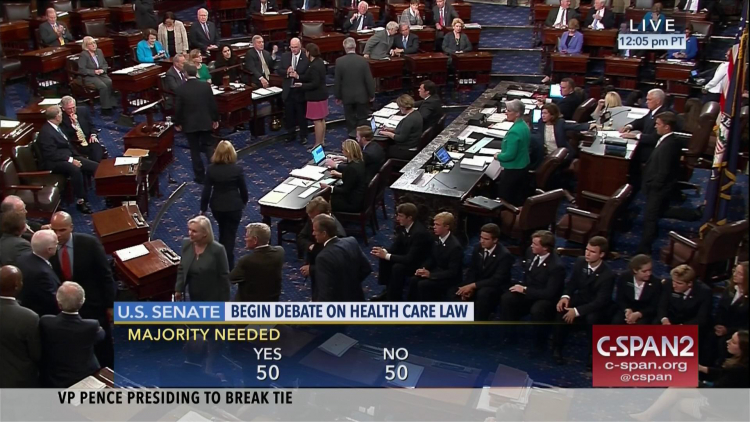

It seems as though only one thing motivates Congress to act – the threat of elections.
That’s why both the House and Senate have moved to pass a continuing resolution to keep funding the government until December. Originally funding was going to run out on Oct. 1, the date that was decided during the last shutdown crisis.

But with virtually every member of the House of Representatives and one-third of the Senate up for election in November, almost no one in Congress wanted to call attention to their own inaction by letting a new shutdown occur.
It’s the political version of Pavlov’s dogs. You know, the famous experiment by the Russian scientist Ivan Pavlov who trained canines to salivate at the sound of a bell because they associated the bell with the expectation of food being served.
The same thing happens with members of Congress when they hear that an election is scheduled within the next three months. Suddenly they want to be productive.
A representative can ignore constituents for 22 months and then suddenly rediscover them during the last two. And senators can become unresponsive to their voters for most of their six-year term, enjoying junkets and the other fruits of power while being under no obligation to get anything done.
Makes you almost sympathize with the Democratic Socialists of America, who have made abolition of the Senate one of their top priorities. Six-year terms have their virtues, but they also make senators especially prone to forgetting who they work for.
But maybe we could salvage the Senate if we could adapt Pavlov’s experiment in a way that would hopefully train senators to do their job on the regular instead of just once in a blue moon.
Call this my modest proposal. Like Jonathan Swift’s famous satirical essay proposing that poor Irish parents sell their infants as food, it isn’t intended as a serious legislative recommendation. It’s meant to expose an absurdity – in this case, a Congress that suddenly remembers how to govern only when voters are about to fire it.
Sadly, the proposal has little likelihood of being put into effect by those senators whom it would put on notice. Yet if its argument is accurate, then we can at least all agree that senators – and yes, all members of Congress – are little more than trained monkeys. If only we could train them well, perhaps they would do their job more consistently.
No doubt you are wondering how we could possibly accomplish such a remarkable goal. It’s a relatively simple mechanism, akin to the bell that Pavlov taught dogs to associate with food.
Namely, the Senate can institute a rule that once a month, the citizen constituents of each state will be able to vote electronically on whether they wish to retain or dismiss their senator.
Now, before you worry about constitutional entanglements and the risk of meddling in the results of such digital ballots, understand that the votes will not be binding. Instead they will simply keep senators on their toes, just as the threat of real elections does today. The results will be widely publicized, and any senator who consistently fails to win majority support from his state’s voters will be publicly humiliated.
But if it were taken seriously, it could have a much wider impact. Political parties could guarantee additional campaign support to senators who consistently earned the confidence of their state’s voters. And the opposite would be true as well. Suppose a senator has only a 30% retention rate from the citizens of his or her state. Donors would flee. Challengers would emerge. Even the most complacent senators might begin to reconsider their inaction.
The genius of elections is not that they remove bad politicians. It’s that the possibility of removal changes behavior long before Election Day. Congress doesn’t need more elections. It simply needs to remember every month that one is coming. Perhaps Pavlov’s bell could do the trick.
And then, instead of Congress passing a continuing resolution to fund the government for a month or two, we could return to regular order and watch appropriations bills passed for an entire year. What a revolutionary concept!