

Banks’ expected demand for central bank reserves and standard refinancing operations
Report from the Eurosystem survey conducted in Q4 2025
The bank treasurer survey is an important tool to gather systematic views about banks’ expected demand for central bank reserves, including through the usage of the Eurosystem’s standard refinancing operations. In order to provide a valuable input into the ongoing monitoring of banks’ liquidity management and the implementation of monetary policy under the operational framework introduced in 2024, the Eurosystem has conducted a survey of its counterparties with two main objectives. First, to estimate the preferred minimum level of reserves[1] that banks aim to maintain under current economic and financial conditions and to identify the key drivers of this level. Second, to assess the expected demand for reserves via the Eurosystem’s standard refinancing operations[2] and its drivers as well as to understand to what extent banks intend to rely on markets for sourcing reserves. The survey also explores how regulatory requirements, particularly those shaping banks’ liquidity management, interact with the demand for central bank reserves.
Survey coverage statistics
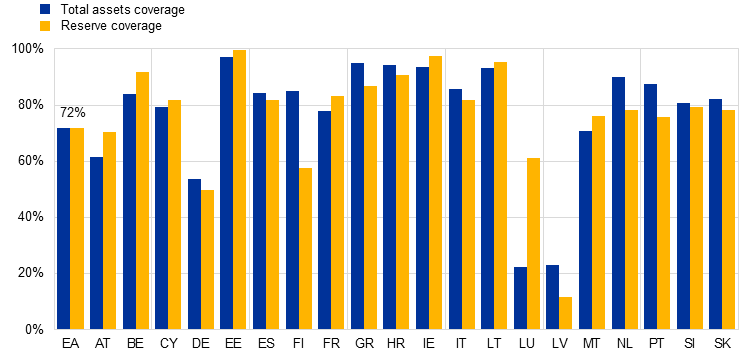
The survey was conducted between 14 and 29 October 2025 with responses from 184 banks.[3] This report provides the summary of the main findings representing bank views about expected reserve demand and SRO demand at the time of the survey. In aggregate, respondents account for approximately 72% of total banking assets and central bank reserves in the euro area (Chart 1). The sample includes institutions of different sizes and business models from all euro area countries, ensuring a balanced representation. This survey has been formulated by Eurosystem staff. Questions do not presume nor should they be interpreted to signal Eurosystem intentions to undertake any particular policy action in the future.[4]
Chart 1
(Share of total assets or total reserves)
a) Coverage per country
b) Coverage per business model
Source: Eurosystem bank treasurer survey Q4 2025, ECB calculations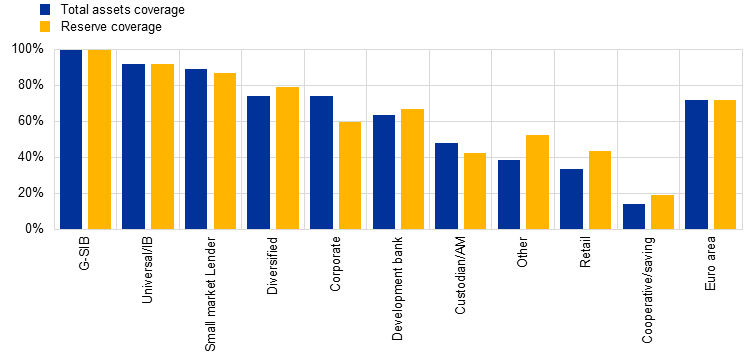
Notes: Responses of 184 banks, where banks answered on behalf of consolidated group, coverage includes consolidated total assets and euro reserves held by all subsidiaries and branches of the banking group. Reserves and total assets Q3 2025. IB – investment banks, AM – asset managers with banking license. Panel b) labels show number of responding entities. Coverage is lower in countries where liquidity is distributed among a high number of small banks and not necessarily indicative of the response ratio of the inquired institutions.
Banks demand to hold significantly more reserves than before the global financial crisis.
The survey aims to obtain an estimate of the aggregate reserve demand of Eurosystem eligible counterparties. Surveyed euro area banks are asked about their preferred minimum level of reserves and the precautionary buffer that they deem desirable to maintain given the prevailing economic conditions.[5] For the purpose of the survey, the preferred minimum level of reserves is defined as the level of reserves that the bank would feel comfortable holding before actively attempting to increase its reserves. In addition, the precautionary buffer is defined as any amount of reserves that the bank intends to maintain on top of the preferred minimum reserve level.
Expected reserve demand is surrounded by considerable uncertainty and remains state-dependent. The answers provided reflect banks’ preferences at the time and, while representative, should be interpreted with caution. Shifts in the economic environment can meaningfully affect banks’ expected reserve demand, which adapts to market conditions.
Banks intend to hold central bank reserves significantly above the ECB’s minimum reserve requirements (MRR). Before the global financial crisis, euro area banks operated with reserve levels just sufficient to satisfy their MRR, also reflecting the Eurosystem’s operational framework at the time.[6] Today, banks intend to hold reserves significantly in excess of the MRR, which currently stands at around 170 billion euros.
Reserve demand depends on banks’ business models and is surrounded by considerable uncertainty.
Banks’ preferred minimum level of reserves depends to a large extent on their business models (Chart 2). Demand for reserves is highly heterogeneous and depends on the structural stability of banks’ funding base linked to their chosen business models. For example, traditional retail banks and diversified lenders indicated the lowest median reserve demand relative to total assets across business models – at around 2% of total assets. In contrast, corporate lenders, custodians and asset managers have a higher relative reserve demand, with the median bank intending to hold 4-6% of total assets as reserves. At the same time, there is a wide dispersion of preferences within business model groups. This reflects a diverse set of drivers that influence reserve demand, including a varying appetite for liquidity risk.
In addition to the preferred minimum level of reserves, some banks opt to also hold a precautionary buffer. Nearly half of the responding banks report that they do not specify internally a precautionary buffer beyond the preferred minimum level of reserves. The remaining banks hold in addition to the preferred minimum a median buffer equal to 0.9% of total assets. The size of the buffer also varies across responding banks.
Chart 2
Preferred minimum level of euro reserves banks wish to hold
(% of total assets)
Source: Eurosystem bank treasurer survey Q4 2025, ECB calculations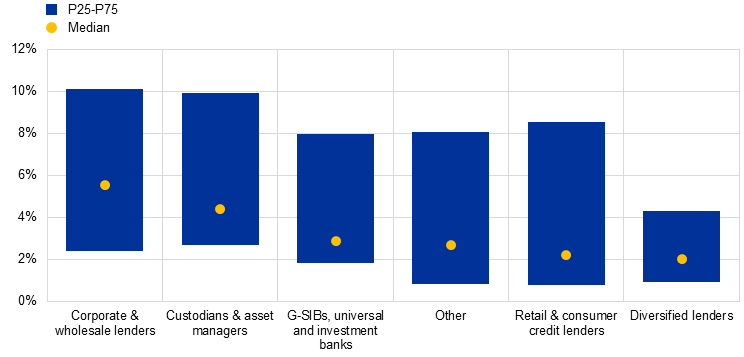
Notes: Responses of 179 banks which provided the answer to this question, grouped by business models and scaled by total assets in Q3 2025. Even if many banks do not internally define their target for reserves, many institutions were able to provide estimated preferred minimum level of reserves they wish to hold given the prevailing economic conditions at the time of the survey. Banks were instructed to provide the level of reserves they would feel comfortable holding before actively attempting to increase reserves by borrowing in the market, raising deposits, taking recourse to the Eurosystem refinancing operations or by other means. Aggregate reserve demand estimates are not disclosed in this survey, nor can it be inferred from the distributions chart. The bars represent 25th and 75th percentiles. Groups are aggregated to preserve anonymity of individual answers.
Drivers of reserve demand
The survey highlights that banks’ expected reserve demand reflects a variety of factors. The most important ones are internal liquidity management practices, liquidity and MRR regulations, expectations about future deposit outflows, supervisory expectations and guidance, as well as a preference to signal a strong liquidity position to investors. Developments in payment innovations and banks’ precautionary motives also explain a portion of the reserve demand (Chart 3).
Chart 3
What are the factors that affect or drive the preferred minimum level of reserves?
(Factors importance ranking from 0 to 3, 0 = not applicable, 1 = limited, 2 = medium, 3 = very important)
Source: Eurosystem bank treasurer survey Q4 2025, ECB calculations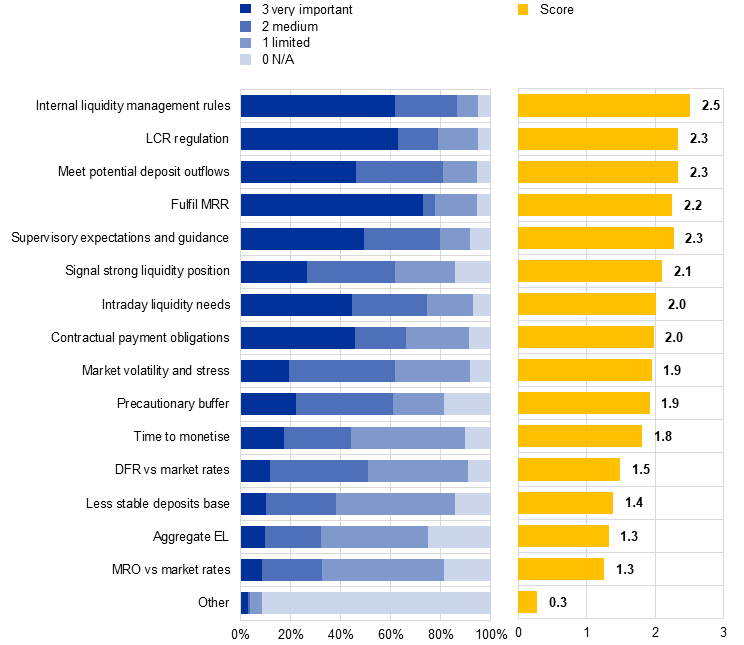
Notes: Responses of 184 banks, ranking scores weighted by total assets in Q3 2025.
Liquidity regulation is a key determinant of reserve demand (Chart 4). The survey reveals that regulatory reforms have changed the way banks operate and manage their liquidity. While only 60% of the surveyed banks set a minimum preferred level of reserves, virtually all entities design their liquidity management practices around the supervisory metrics such as the liquidity coverage ratio (LCR) or the net stable funding ratio (NSFR). In the survey, banks indicated that they set internal LCR and NSFR targets significantly in excess of the 100% regulatory minimum, reflecting the level of risk appetite banks are willing to accept.
Chart 4
Internal liquidity management targets – Does your institution have specific internal targets for the following liquidity indicators?
(Share of respondents with each internal target)
Source: Eurosystem bank treasurer survey Q4 2025, ECB calculations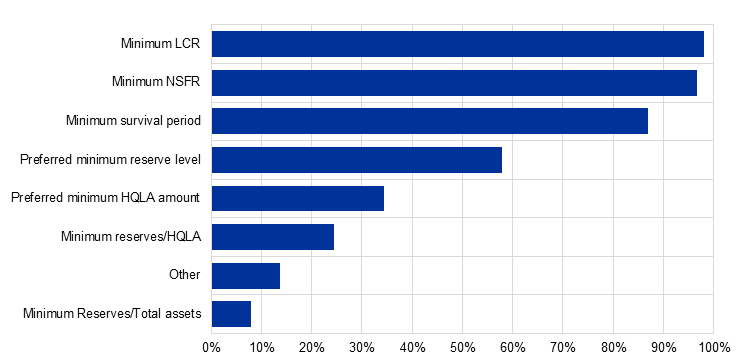
Notes: Responses of 184 banks in Q4 2025, ranking scores weighted by total assets in Q3 2025.
Euro area banks are primarily focused on actively managing their liquidity targets (LCR and NSFR) and are, for now, less focused on their reserve levels (Chart 5). When asked how binding each target is, a large share of respondents indicated that the LCR and the NSFR were already binding or might become binding soon. While more than half of the respondents highlight that the absolute level of reserves is not yet binding, around a fifth, mostly diversified lenders and retail-funded commercial banks, consider this target to be binding already now (dark blue bars).
Chart 5
How binding do you consider these targets to be in the near future as the aggregate amount of reserves in the banking system continues to decline?
(Rate how binding is each liquidity target on a scale 0-3)
Source: Eurosystem bank treasurer survey Q4 2025, ECB calculations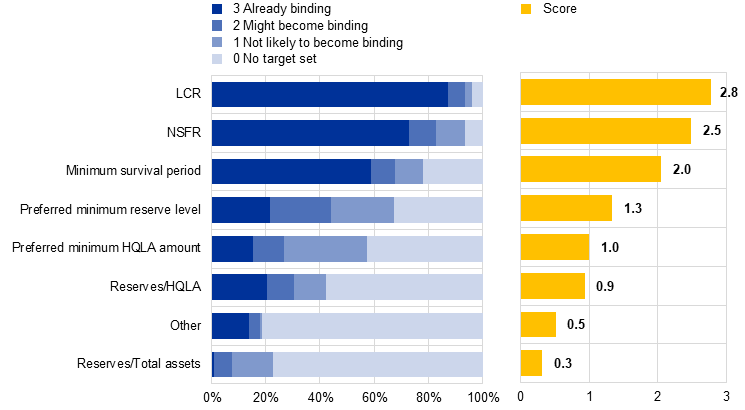
Notes: Responses of 184 banks, ranking scores weighted by total assets in Q3 2025. Ranking scale: 0 – the target is not applicable or is considered as non-binding, 1 – target is not likely to become binding, 2 – target might become binding, 3 – target is already actively steered and considered binding for my institution.
While aggregate excess liquidity will continue to decline, most bank treasurers expect their reserve positions to remain broadly stable (Chart 6). According to the redemption profile of the Eurosystem monetary policy portfolios, aggregate excess liquidity is expected to decline by around 20% over the course of 2026.[7] However, banks foresee their reserve positions, and also liquidity metrics such as the LCR and the NSFR, to remain broadly stable (grey bars). In fact, only 2% of respondents expect their reserves to decline by more than 10 percentage points by the end of 2026 (dark yellow bar) while a further 8% of respondents anticipate a moderate decline in reserves between 5 and 10 percentage points (light yellow bar). When accounting for the relative size of banks, the average treasurer expects even a mild increase in its bank’s reserve position over the coming 12 months.
Chart 6
Expected evolution of liquidity position as the aggregate amount of reserves in the banking system continues to decline
(Weighted share of total assets of respondents each target)
Source: Eurosystem bank treasurer survey Q4 2025, ECB calculations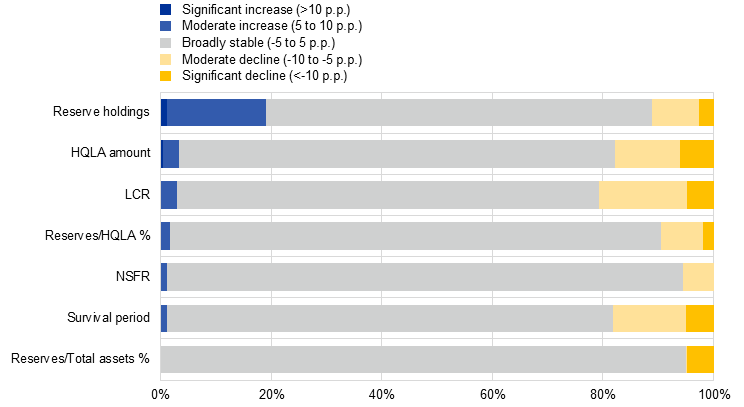
Notes: Responses of 184 banks, ranking scores weighted by total assets in Q3 2025. The charts show only banks which set each internal target, therefore each row contains different number of respondents.
Reaction function to a potential liquidity shortfall
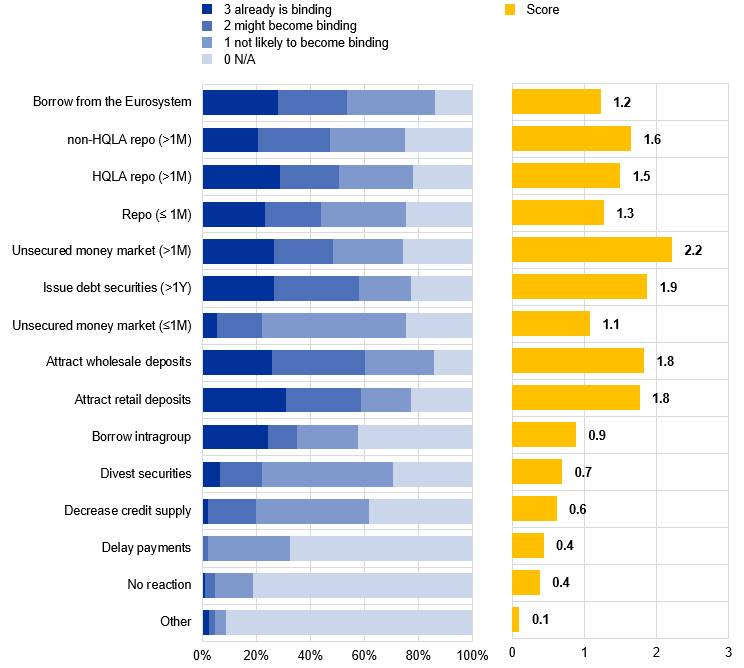
The survey reveals that, in case of a liquidity shortfall, most banks would first tap term money and bond markets and attempt to attract wholesale and retail deposits (Chart 7). In normal market conditions banks aim to make recourse to the most agile liquidity tools, which also provide regulatory value. These include unsecured term money markets, e.g. issuance of commercial paper (CP) and certificates of deposit (CDs), issuance of debt securities, as well as attracting unsecured wholesale and retail deposits. Term repo markets are also a useful tool to source liquidity for longer maturities.[8] This is in line with the finding that banks are focusing more on the LCR and the NSFR than on their day-to-day reserve position.
Chart 7
Reaction to liquidity shortfall
(LHS: share of respondents unweighted, RHS: weighted importance score)
a) Planned reaction in normal market conditions
b) Planned reaction in normal market conditions vs stressed market conditions
Source: Eurosystem bank treasurer survey Q4 2025, ECB calculations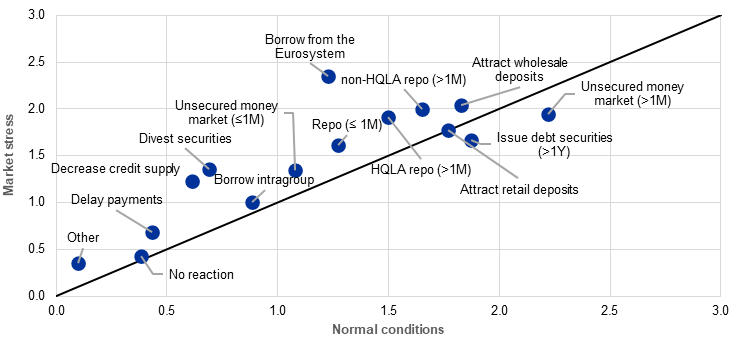
Notes: Responses of 184 banks. The question asked banks what measures would a bank take if the liquidity position is projected to fall below the internal highly binding liquidity target. For some banks this could be the level of reserves, LCR, NSFR or other liquidity targets. Unsecured money markets with maturity above 1 month consist of commercial paper and certificates of deposits issuances and could include also term deposits of financial counterparties.
In stressed market conditions, banks are more likely to turn to secured markets. In times of stress, the marginal price of liquidity increases, and access to certain market segments might become more limited or in extreme situations fully shut down. Banks acknowledge the risk premia associated with securing liquidity in stressed market conditions and indicate that they would be more willing to increase secured borrowing, either by turning to the repo market or by borrowing from the Eurosystem via standard refinancing operations (SROs) against eligible collateral. In particular, term unsecured money markets, such as the issuance of commercial paper and debt securities are assessed as less reliable sources of funding than in normal times.
Foreign reserve demand
European banks flexibly allocate cross-currency reserve holdings depending on money market conditions in each jurisdiction.
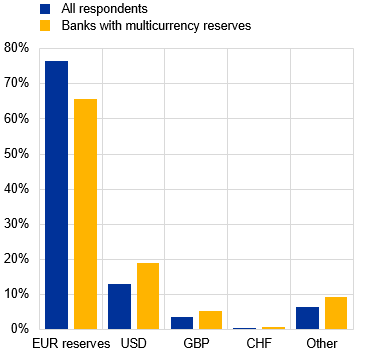
Euro area banks are important players in global financial markets and hold reserves with foreign central banks, not just the Eurosystem (Chart 8). Many banks are globally active with subsidiaries and branches across various jurisdictions and with access to multiple central banks. This is not only reflected in multicurrency reserve holdings but also in the currency-specific reserve demand. The largest banks representing 40% of the survey sample hold reserves also in currencies other than the euro. Most popular foreign reserves include the US dollar, the pound sterling and the Japanese yen. Jointly those foreign reserves represent around a quarter of sampled banks’ reserve holdings (left hand side chart).[9]
Chart 8
Foreign central bank reserve management
|
a) Share of reserve holdings per currency |
b) Approach to multicurrency reserve holdings |
|---|---|
|
(Weighted share) |
(Weighted share) |
 |
 |
Source: Eurosystem bank treasurer survey Q4 2025, ECB calculations
Notes: Responses of 184 banks, 48 respondents representing 40% of the total assets of surveyed banks reported holding also non-euro reserves. RHS chart shows weighted share of the banks holding non-euro reserves depending on the flexibility of their foreign reserve management.
For banks holding foreign reserves, those reserves can be deployed flexibly across jurisdictions (Chart 8). Almost 80% of banks reporting holding non-euro reserves stated that the reserve allocation between currencies is relatively or highly flexible (right hand side chart). Bank treasurers have indicated that flexibility arises from utilising the excess reserves in each jurisdiction to benefit from money market rates arbitrage, particularly in relation to central bank operations.
Plans for using SROs
Standard refinancing operations (SROs) play a central role in the Eurosystem’s operational framework. Banks can borrow from the Eurosystem through the MROs and 3-month LTROs to meet their liquidity needs on demand. The SROs are available on demand at a fixed rate with full allotment, with a 15 basis point spread to the DFR against a broad collateral set. Given the central role of SROs, assessing banks’ expected demand and the motivation to participate is critical for monetary policy implementation. So far, the recourse to SROs has remained limited with no more than EUR 37 billion supplied since 2024, as excess liquidity remains abundant.
The survey reveals that most banks currently do not plan on participating in SROs in the near term. Only a few surveyed banks expressed plans to participate on a regular basis in these operations in the coming three years (blue bars, left hand side Chart 9). Among those banks that do not have a concrete plan for participation (yellow bars, left hand side), many respondents show willingness to perform operational readiness tests (yellow bars, right hand side). As reserves continue to decline it will be important for banks to be operationally ready to use Eurosystem SROs as routine tools to manage their liquidity.[10]
Chart 9
Planned participation in standard refinancing operations
|
a) Planned time of participation |
b) Planned type of participation |
|---|---|
|
(Weighted share of respondents) |
(Weighted share of respondents) |
 |
 |
Source: Eurosystem bank treasurer survey Q4 2025, ECB calculations
Notes: Responses of 184 banks, weighted by total assets. The LHS chart shows the share of banks that foresee a positive average recourse to the SRO per year in blue, those that plan zero recourse in yellow and undecided banks in grey. Single operational test would not be captured by an average recourse per year. Other includes combination of factors or more specific plan for SRO usage.
Some banks plan to take stable or recurring recourse to the SROs (Chart 9). The share of banks with concrete SRO participation plans currently stands at 15% (blue bars, right hand side chart), with 11% of banks forecasting short-lived but likely recurring usage of the operations and further 4% of respondents incorporating SROs in their bank funding plans (blue bars, right hand side chart).
Drivers of SRO participation
Chart 10
Drivers of demand for standard refinancing operations
(Relevance score from 0 to 3)
a) Motivating factors

b) Discouraging factors
Source: Eurosystem bank treasurer survey Q4 2025, ECB calculations
Notes: Responses of 184 banks, weighted by total assets.
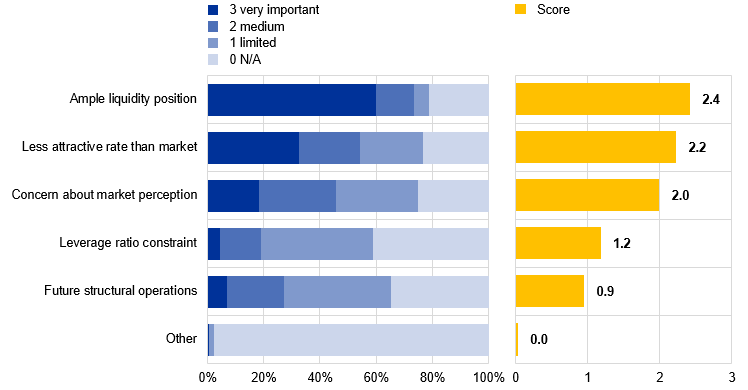
The expected demand for SROs reflects a number of considerations (Chart 10). Banks intend to borrow from the Eurosystem (i) when SROs become more attractive than comparable market funding, (ii) when market access was impaired or (iii) if banks needed to increase their LCR (top panel, blue bars).[11] Limited market access remains a relevant factor across institutions, regardless of their size or market share.
Banks’ limited intention to participate in SROs largely reflects ample liquidity positions and favourable market funding conditions. At present, an ample liquidity position stands out as the most significant discouraging factor for banks when considering participation in SROs (lower panel). Moreover, banks see market pricing as more attractive than the MRO rate. Additionally, concerns about how participation in SROs might be viewed by investors, credit rating agencies or other stakeholders emerge as additional considerations.[12] In this context, it is important to stress that banks making greater use of monetary policy operations over the coming years will not be a symptom of liquidity stress but will rather reflect their day-to-day liquidity management in the context of the ECB’s operational framework.[13]
Governance of SRO participation
Decisions on SRO participation are predominantly taken at senior levels, with bank treasurers and executive management playing a central role in the approval process (Chart 11). In most institutions, the treasurer plays a central role in the approval process, reflecting the importance of liquidity, funding and balance sheet considerations. However, executive management is also frequently involved, signalling that SRO participation is currently viewed as a strategic decision rather than a purely operational one. The involvement of asset and liability committees and risk management functions further suggests that banks assess SRO participation in the broader context of their risk appetite, balance sheet structure and overall funding strategy.
Chart 11
Further considerations on SROs
Governance approval process
(Weighted share of respondents)
Source: Eurosystem bank treasurer survey Q4 2025, ECB calculations
Notes: Responses of 184 banks in 2025. Banks were able to select multiple options regarding the governance approval.
© European Central Bank, 2026
Postal address 60640 Frankfurt am Main, Germany
Telephone +49 69 1344 0
Website www.ecb.europa.eu
All rights reserved. Reproduction for educational and non-commercial purposes is permitted provided that the source is acknowledged.
For specific terminology please refer to the ECB glossary (available in English only).
PDF ISBN 978-92-899-7983-2, doi:10.2866/8014393 QB-01-26-187-EN-N
HTML ISBN 978-92-899-7982-5, doi:10.2866/9105802 QB-01-26-187-EN-Q